

Corona
By Tom Ketlogetswe, Thapong Visual Arts Centre, Botswana
Your strength is not in doubt
You are stronger than many imagined
Nations are perishing
Locals are hiding in fear
Your strength knows no boundaries
Your sweeping powers are unimaginable
Leaders across the globe shiver
Heroes are neither spared
The poor have no place to hide
The rich are contemplating hiding in cosy closets
You have unleashed your strength
Indeed you have surpassed your immediate predecessors
Copyright: Tom Ketlogetswe 2020


Photo essay - Clean Air Project Launch
By Reagan Kandole, Dalton Otim, Anthony Kadoma and Vanessa Duclos
The proliferation of plastics globally is now a major challenge, especially over the last two decades. Worldwide, we are producing over 300 million tons of plastic each year, 50% of which is for single use purposes. More than 8 million tons is dumped into the ocean yearly, becoming a big environmental issue and threat to our ecosystems and biodiversity. Kampala city, Uganda, generates 750 tons of waste a day of which half is collected and sent to the dumpsites. The other half, mainly plastics and polythene, is irresponsibly disposed and finding its way from our communities and streets, to drainage channels, to rivers, lakes, and wetlands.

Photo Credits: https://www.ecolife.zone/reducing-single-use-plastics/
This problem is even more prominent in the urban slum dwellings. School setting is one of the best platforms for promoting proper solid waste management through education, skills workshops, and fun activities outside classrooms, hence enhancing teamwork. By sensitizing the children, behavior changes can be fostered around proper waste management.
ECOaction, an SFA Network NGO partner, together with Kampala City Council Authority, AEIF Alumni 2019 and five primary schools in Kampala City (Namirembe Infants School; Bat Valley Primary School; Kawempe Muslim School; St Ponsiano Kyamula School and Luzira Church of Uganda School) received funding from the Ugandan US Embassy to implement the “Clean Air Project” in 2020.
The following photo essay takes you through the launch event, which took place on March 6th 2020.


Pluriversal Literacies: Affect and Relationality in Vulnerable Times
By Vanessa Duclos, Research Manager, Sustainable Futures in Africa
Dr Mia Perry, SFA Co-Director, has just published (April 6th) a brilliant paper* entitled: “Pluriversal Literacies: Affect and Relationality in Vulnerable Times” in International Literacy Association – Reading Research Quarterly. This is a timely publication amid the current COVID19 crisis worldwide.
Abstract
Through a consideration of literacies in theory and international policy, this article pushes at the edges of existing frameworks of functional and sociocultural literacies. In critique of existing policy directives, the author explores an approach to literacy that engages in the affective and posthuman relationality of human and environment and in the plurality of literacies globally that are overshadowed in prevailing models of literacy education. The author was motivated by a commitment to literacy education responsive to a world that is unsustainable in its current practices, to a world that faces increasing fragmentation and vulnerability (socially and ecologically) while certain types of expertise, technologies, and global infrastructures continue to proliferate. As a mainstay of education and a tool of social change, literacies are inseparable from policy and practices of sustainability, equity, and development. Pluriversality is a concept emerging from decolonial theory that provides a counternarrative to contemporary Northern assumptions of the universal. Building on a history of ideas around pluriversality gives sociopolitical and ecological momentum to affect and relationality in literacy studies. The author challenges normative constructions of literacy education as Eurocentric and neocolonial, effectively supporting a pedagogy that normalizes certain practices and people and, by extension, sustains inequity and environmental degradation. Through interwoven research projects, the author highlights the contentious aspects of functional and sociocultural approaches to literacy and the possibilities of moving beyond them. In doing so, the author describes and demonstrates the practical and political implications of affect theory and relationality in literacies education in a plural anthropocenic world.
” It is a paper that I have been working on for over a year and our very own Dr Alex Okot is quoted, EcoAction is featured and the Sustainable Future in Africa Network acknowledged throughout for the immense influence this network has had on my work in literacies “ – Dr Mia Perry
* Mia Perry. 2020. Pluriversal Literacies: Affect and Relationality in Vulnerable Times. International Literacy Association – Reading Research Quarterly. 0(0). pp 1-17 | doi:10.1002/rrq.312

COVID-19 and Rethinking the Unsustainable “Normal”
By Dr Deepa Pullanikkatil, Co-Director, Sustainable Futures in Africa
Reconsidering Development Pathways: What is the “New Normal”?
“Sustainable Development”, that often overused term in development work, calls us to action to end poverty, protect the environment and ensure that all people enjoy peace and prosperity. However, our development pathways have been far from that ideal. With rising inequality, increasing carbon emissions, pollution, wildlife crime, and the exploitation of natural resources and environmental degradation, we have continued our immoral growth beyond the carrying capacity of our earth. COVID-19 may be a wake-up call to humanity to stop this self-destruction of our home planet, lest our actions eliminate us as a species.
Reflecting on the status of the world
With the majority of us under lockdown in our homes, this is a good time to pause and look at our lives, our countries’ priorities, global development and the meaning of sustainability. While we have advanced our knowledge about green economic models, good practices for reducing extreme poverty and the use of technologies to promote wellbeing, we still have 700 million people living on less than $1.90 a day. Our consumerism and continued emissions are compromising our chances of limiting global warming to 1.5°C, and our global health care inequalities have come to haunt us.
Should we go back to “normal”?
Many of us can’t wait to get back to the same “normal” that got us into this predicament. COVID-19 has revealed that this pathway of unsustainable consumption, growth, ecological degradation and inequality simply cannot continue. In an increasingly interconnected world, the pandemic has taught us that none of us is safe unless all of us are safe. Business-as-usual may not be the “normal” we want to return to.
Economic slowdown may not be all that bad
This is also a good time to reflect on what life looks like when we slow down economic growth. With air travel grinding to a halt and a large number of people working from home, we are seeing the prevalence of digital conferences and meetings taking off, making us wonder why working remotely and meeting locally wasn’t already a norm? With the lockdown, the burning of fossil fuels has dropped, causing air quality to improve significantly, triggering social media posts of beautiful clear skies and views of mountains kilometres away. With humans locked in, animals and birds are courageously stepping out and enjoying their newfound freedom. The earth is healing.
We can work together
All sectors are working hand in hand to tackle this pandemic: funds are flowing from various sources; the private sector which hitherto cared mostly about profits is stepping in and helping the health sector. Governments are realising that spending on key sectors such as health and education is more important. Scientists and doctors are collaborating for the greater good, development partners are giving NGOs flexibility to divert their funding to COVID response, and each of us is checking in on our friends and family. It took this pandemic to ignite our sense of community, to get us to make sacrifices, recognise our priorities, work for a common purpose and cherish solidarity. We now realise that we’re all in this together and we can work together.

Three lessons learnt
Three things have become clear since the emergence of COVID-19. First, we are an interconnected world and only if all of us are safe, will each once of us become safe. In that regard, the virus is an equaliser because it does not discriminate. Second, although the virus has impacted every country, regardless of wealth or power, it has also made us realise how unequal our society is. There will be many who will not be able to recover at all or recover as fast as some others. Our global interconnectivity should wake us up to our responsibility for ensuring that each and every country recovers from this shock (not just our own country). We can no longer afford to be selfish, we have to broaden our minds and assume a global identity.
Finally, the unsustainable “normal” that has caused so many challenges to the world is a social construction; that means, we can change it. We, as a society, have been able to come together and make drastic changes to our lives and economy to respond to COVID-19. This proves that it is possible to take action to create a changed future for the better. After the pandemic ends, we must not slip back to the old normal, but consciously strive towards a “new normal” that is more sustainable, climate-proof, equitable, compassionate and humane.
What is your idea of the “new normal”?
How would you envision this “new normal”? Drop your answers/comments below.

Waste management in small urban context - Malawi
By Dora Nyirenda, Research Administrator of the Malawi hub
On January 11th 2020, I had the privilege to visit the Mzuzu (Nsilo) dumpsite located in the Northern part of Malawi. This opportunity arose while making arrangements for the symposium/workshop that was initially planned to take place in Mzuzu, Malawi.
The dumpsite was a project of Mzuzu City Council in conjunction with Plan Malawi, implemented with funding from the European Union. The facility was to be finished and put into use in 2017, but unfortunately, the place started being used without being fully finished, which made it a place that was perfect for breeding flies due to the lack of waste management. This is especially problematic because the facility is close to people’s homes and a primary school and that flies can be a vector of many diseases and infections.
I visited the area where the dumpsite was when the people were protesting on the 10th January 2020. I asked one of the community members why they were protesting, and she said, ’The unfinished facility is breeding and harbouring a lot of flies. We cannot eat or prepare our foods in the open as the flies land in our food, which puts our health at risk.’ It was on that day that the angry and concerned community members set fire to the facility, which has been closed.
This marked the end of the people’s patience. Before the facility was set on fire, the community members were promised that chemicals would be applied frequently to kill the flies, but this was not happening. The dumpsite was close to a primary school, meaning that flies were landing in the school children’s food.
One of the community members said, ‘We were told that the facility would have machines inside that would be processing and grinding the waste, and that the end product would be manure, which would even benefit the community. But this has not been happening as the facility started being used before they finished constructing it.’ This raised the interesting question of whether the community gave a consent to the facility’s construction or if they were even asked for their views and concerns before the dumpsite project was implemented. This is an example of a problematic situation where planners did not consult properly the local communities and where the implementation of the initiatives did not lead to the expected outcomes. Unless environmental initiatives are context appropriate and involve local communities from inception, the impact can’t be guaranteed.
The Malawi hub is working on a project proposal to investigate the local challenges in implementing solid waste management in Mzuzu and to facilitate the identification of potential situated solutions.


Reflections from Ten Years of working in Climate Change Adaptation
By Dr Deepa Pullanikkatil, SFA Co-Director
As the year comes to an end, I realized that it has now been ten years since I began working on Climate Change Adaptation. I have an overwhelming sense of gratitude and happiness looking back at one decade of following my passion. Here, I do a self-reflection on the journey of past years; touching on experiences, challenges, growth and learning opportunities.
Ten years ago, when I was working as a Lecturer in Civil Engineering in Lesotho, my voluntary “industry attachment” at the Department of Meteorology in Maseru city, led me to be a Co-Applicant for a US National Science Foundation funded START Global Environment Change Research grant. We undertook research on how climate change impacted subsistence farmers in Lesotho. The 120 households we interviewed told us that food crops are the most vulnerable to weather particularly frost damage, hail, drought and dry spells, which reduced crop yields. Although it was a small research project, it was one of the first researches of its kind in Lesotho and gave baseline information on this subject. Today, we know that with climate change, heavy snowfalls, strong winds, floods and droughts are expected to continue to affect the country, posing a direct threat to sectors such as agriculture, forestry and infrastructure.
By end of 2009, my husband got an assignment in Malawi and we moved to picturesque Zomba city in southern Malawi. I started volunteering at the Wildlife and Environmental Society of Malawi and prepared a book on birds which were distributed freely through Danish funding to 400 primary schools. At the launch of the book, I met the Director of a prominent NGO; Leadership for Environment and Development (LEAD), who gave me an opportunity to work with LEAD for almost five years. It was a chance to do some varied and interesting work, such as compiling the State of Environment Report for Malawi, developing the National Climate Change Policy for Malawi, compiling a Stocktaking Report for Rio +20 for Malawi, reviewing the Decentralized Environmental Management Guidelines for Malawi, conducting studies on Advancing Green Economy through Technology Transfer, on impacts of Lake Chilwa drying in 2012/13 and on Bilharzia prevalence. Through this work, I learnt about the interlinkages between various sectors and climate change.
It was clear that Malawi needed substantial funding for climate change adaptation. Fortunately, we got a chance to successfully develop a Global Environment Facility proposal, which went on to get $6million for climate proofing of local development gains in two districts of Malawi. This has supported over 0.5 million people to receive knowledge, tools, capacities and methodologies for the adoption of an ecosystems and community based approach as well as integrating climate risks into adaptation measures.
LEAD and partners implemented the Norway Government funded Lake Chilwa Basin Climate Change Adaptation Programme, with interventions that included tree planting, training on climate change, setting up drama groups and radio clubs, building fuel efficient fish smoking kilns, solar fish dryers, weather monitoring stations, linking farmers to markets, conservation agriculture training, fuel efficient stoves promotion and setting up a radio and TV station. The experience helped me understand the importance of using an integrated approach, as communities live integrated lives, not in “siloes” of sectors. Adaptation efforts just focusing on one sector may not be as effective. Lake Chilwa communities demanded that we not only look at income generation and livelihood building activities but also to look at health and family planning.
Consequently, from the Lake Chilwa Project, we published a report on the Linkages between Population, Reproductive Health, Gender and Climate Change Adaptation and went on to disseminate this widely to funders and policymakers both nationally and internationally, including at the International Conference on Family Planning in Ethiopia to Woodrow Wilson Center and Capitol Hill in Washington DC. We are confident that this has inspired projects that came afterwards to take a more integrated approach to adaptation efforts.
We are conscious that Climate Change affects those who contributed least to it, particularly those in developing countries and this has led to a climate justice movement. The Scottish Government supports this thinking and their Scottish Climate Justice Fund (SCJF) provides funds to countries like Malawi to cope with climate change impacts. I was part of two projects funded by SCJF, one on Solar Energy Kiosks and the other on Water Resources and climate change. From the Solar Kiosk project, I understood that when piloting a technology, understanding community socio-economic status is key to make the project a success or failure. From the Water Resources project, I learnt that it is important for decentralized structures and Government officials to be involved from the beginning for the project to be sustainable. From December 2019, I am part of a new project also funded by SCJF which will look at energy issues in Malawi, coming up with a novel communal cooker using waste as input. This project is led by the University of Glasgow.
The work at LEAD also piqued my interest on ecosystem services, particularly on provisioning ecosystem services, as it impacts on the lives of natural resource dependent poor communities. I got interested in a fragile yet productive ecosystem, the “Likangala River Catchment”, and this ended up becoming my PhD study. The ecosystem provides so many benefits including edible wild animals, wild plants and fungi, medicinal plants, construction materials, ornamental flowers, firewood, honey, gum, reeds and thatch/weaving grasses. Human activities such as land use change had affected the provisioning ecosystem services and water quality. With climate change, such fragile ecosystems will be affected and the natural resources dependent communities who live off them will be affected.
In 2015, we moved to The Kingdom of Eswatini following my husband’s job and I began volunteering at the Coordinating Assembly of Non-Governmental Organizations (CANGO) Recommended by CANGO, I was engaged under a United Nations Environment funded project as the Climate Change Adaptation consultant for Eswatini’s Technology Needs Assessment (TNA) for climate change management. The TNA prioritized the sectors and technologies that the country needs as it adapts to climate change. I received support from many people particularly the stakeholders and guidance from the Ministry of Tourism and Environmental Affairs, which moved me to look at this project as an “Ubuntu” inspired journey. Already some projects in Eswatini are using the information from the TNA, which is heartening to note.
In 2016, I went back to Malawi to start a non-profit organization with some friends, which we called “Abundance”, inspired by nature which is plenty and regenerating. Based on my past experiences, we used an integrated approach with deep focus on the community and activities are driven by community needs, building self-reliance. It is a completely voluntarily run organization and the dedicated team in Malawi are fantastic! The same year, I was approached by a colleague from the University of Glasgow to join the Sustainable Futures in Africa network. It appealed to me because the network uses a decolonial approach to our work and explore the relationship between social, cultural, and ecological factors in sustainability in Africa through interdisciplinary research initiatives. Co-Directing this network with Dr.Mia Perry with members from Scotland, Nigeria, Botswana, Uganda and Malawi is a pleasurable and stimulating experience. Abundance as an organization is also part of the network. Through the network, I had a chance to have a residency at the University of Glasgow in 2018 and give talks at the University on the lessons learnt from my work in Africa.
A friend in my PhD cohort linked me with a consultancy firm in South Africa (Gibb). Through them, I was able to undertake a regional consultancy work to compile the Southern African Development Community (SADC) Climate Change Year Book, covering 15 countries which was published in English, Portuguese and French. My interest in research continued to bubble within me and led me to undertake a Post-Doctoral Fellowship at Rhodes University in Grahamstown (Makana), South Africa. This culminated in a few journal articles and a book on Poverty Reduction through Non-Timber Forest Products, with case studies from six continents, which was published by Springer. I am now back in Eswatini and with colleagues supporting the National Disaster Management Agency (NDMA) to build capacity to develop proposals tapping on to climate finance. Disaster Risk Reduction and Climate Change Adaptation are two sides of the same coin, I have come to understand as I work with NDMA.
Ten years ago, changing my career from civil engineering to environmental science and working on climate change adaptation and global development seemed like a risky thing to do. Looking back, I know it was right move. The transition would not have happened if I had not connected with supportive colleagues and mentors who guided me through this journey; and family and friends who were understanding throughout. It is tremendously satisfying to work on climate change adaptation, which is very pertinent today. However, at the moment, I also have a sense of anxiety for the future; about climatic stressors that will make permanent and temporary changes to ecosystems and the implications for losses and damages to people and society. As we make New Year’s Resolutions, let’s make some resolutions to make personal and collective action to save the planet. Let us contribute less emissions towards climate change, let us help with adaptation efforts.

Reporting on: Future Experiences | Glasgow School of Art (Expert Day 2)
By Vanessa Duclos, Research Manager of the SFA Network
Today (Nov 7th, 2019) was the second opportunity for the emerging designers to engage with the experts in Sustainable Development & the Global South. For more information about the project itself, please read this post.
The students presented the concept scenario they had developed as a team, as well as their individual direction which is a specific aspect of the future world they have created. These individual parts will lead to the design of distinct, imaginative and interrelated products, services and experiences. While designing, the students must keep in mind who they are designing for – future workers/future citizens – with consideration for how Sustainable Development work might evolve to enable/afford/alter the dynamics of people, process and practice in the Global South.
As most of them have never travelled to a destination in the Global South, they largely rely on the experts’ lived-experiences to grasp the reality of those living in developing countries. I was pleased to realise that as the emerging designers broaden their research and interact/interview the experts, they also start integrating what working across difference means, that there is more than often no “right” or “wrong”, “bad” or “good”, “them” and “us”, which are too easy and simplistic labels used to describe the disparity between the North and the South. I notice that they all felt more comfortable exploring the grey zone between both worlds where ideas and concepts can emerge, instead of stagnating in a criticism loop. While they learn from our experience, we also greatly learn from their creativity, flexibility, and open-mindedness which are skills that requires time and exposure to develop but which seem to be well built-in and natural for this group.


Impact Story from Nigeria: Policymakers Engagement on Artisanal Gold Mining
By Grace Idowu Awosanmi and Deepa Pullanikkatil
Dr Sola Ajayi, a Professor of Agricultural Science in Ile-Ife, Nigeria, got interested in agriculture through his experiences and observations growing up in a farming community. He is now the Director of the Nigerian hub of the Sustainable Futures in Africa (SFA) Network, a global network comprising members from the United Kingdom, Nigeria, Uganda, Malawi and Botswana. “Being auniversity teacher and a Professor of Agriculture gave me the desire to understand communities in a holistic manner,” says Ajayi. “I look at the issue of community development more than just that of agriculture because I know that the development of communities is a result of so many interwoven factors. This was my attraction for joining SFA.”
Since 2014, Ajayi has been researching the nexus between artisanal gold mining and agriculture. He has conducted several field visits and partnered with other universities (notably Goethe University in Germany and Murdoch University in Australia) on issues relating to mining, community relationships and social engagement. So at the inaugural SFA meeting in Botswana in 2016, where hub countries were offered seed grants and asked to come up with projects, Ajayi presented the idea of ‘Prioritizing developmental needs in agrarian and mining communities’. The research question was: What is the priority for artisanal mining communities in the face of limited resources? A variety of methods were used by Ajayi and his interdisciplinary team, which included Prof. Akande from Adult Literacy and Lifelong Education and Prof. Torimiro from Agricultural Sociology.
Ajayi recalls, “As we progressed, there came an escalation in the problem of artisanal mining per se, which also extended to both my immediate environment at Ile-Ife and to the community where I was born. The issue of artisanal mining in Nigeria spiralled to become a security issue that was also threatening the social fabric of communities where these issues were taking place. Therefore we decided to narrow it down and then look at it in context.”
Mining in Itagunmodi
About a year after the start of the SFA project, the government of Nigeria came up with the idea of changing its developmental paradigm to focus on agriculture and mining. They wanted to reduce the dependence of the Nigerian economy on oil, targeting other aspects of the economy instead. This prompted the SFA team to ask, “If the government considers mining and agriculture to hold the key to economic diversification, why are the communities where these activities take place poor?”
Their interest in this question led them to the village of Igbojaye, located in Oyo State. The community is strategically located within a strongly traditional institutional environment. Itagunmodi is less than 20 km from Ile-Ife, which is regarded as the source/origin of the Yoruba race. However, with the rise of mining and the influx of migrants it brought to the area, the Itagunmodi Kabiyesi (king) had been displaced and had to leave the community. The Yorubas are predominantly farmers, traders and learned people. Therefore, migrants from the north of the country came for the jobs, displacing the original members of the community. Two in every three occupants of the community is a migrant Northerner who does not speak the local language. Prof Ajayi recalls an instance in Itagunmodi when the Jumat prayer was spoken in the migrants’ language. “The migrants were no longer learning the native language. Rather the few natives that were there were learning the language of the migrant miners. We also saw a shift in the kinds of business activities, in the kinds of food in circulation, culture and even the music played on the street. All these no longer reflected the culture of the people.” It was alarming to the locals that Itagunmodi was now being taken over by people of another tribe, and it was seen which was now a major security concern.
As tensions rose in Itagunmodi, Prof. Ajayi spoke with various concerned parties, including the Honourable Commissioner for Environment and Community Leaders and Traditional Rulers, the Deputy Governor of the State and the Chief of Staff of the State. The Chief of Staff was very glad that the SFA team had come to provide research-based perspectives and to draw the government’s attention to the issue, and eventually some of the information they provided led to the convening of a security meeting.
Ajayi also spoke to the Commissioner of Police for Osun State, who was not aware of the security implication nor that the situation had degenerated so much. The Commissioner later informed Ajayi that there would be a Security Summit, which was widely covered in the national dailies. Ajayi also spoke to a very significant and influential indigenous personality, who is presently the Director-General of the National Chamber of Commerce and Industry (and was previously Nigeria’s ambassador to Australia), whom he had met during a research project collaboration. This led to the SFA group being put in charge of mining-related issues for the Chamber of Commerce and Industry.
At that time, the Development Agenda for Western Nigeria (DAWN) Commission, a group tasked with the sustainable development of the predominantly Yoruba-speaking southwest region, asked the SFA hub to prepare a presentation that would inform the policy of the commission on the issue of mining and artisanal mining. Ajayi is happy that through SFA, he has been able for the first time to engage with policy makers and provide empirical evidence that can form the opinions and positions of both government and traditional institutions. He says, “The goal of the project is not just research. The way I understand it, research is not an end in SFA, research is a means to an end and the end is the development of the community. We want to facilitate development not just as an academic exercise but as a daily experiential activity. So research is only a component of it to the extent that it serves to provide solutions, understanding and index analysis that will bring out solutions to problems. The development will involve members of the community, whether they are natives or migrants. Everyone that lives, everyone that transacts, everyone that has a stake in the community is a stakeholder so they need to be actively engaged. It will involve regulatory authorities, government authorities, traditional institutions and the people. It is important to engage people since the facilitation of development is something that can not be done alone.”
Women Environment Programme Wins Nigerian Energy Award
By Deepa Pullanikkatil, Co-Director of the Network
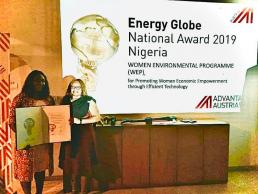
It was a proud moment for Women Environment Programme (WEP) when the 2019 Energy Globe National Awards in Nigeria were announced and they were declared winner. The technological innovation that got them the award was the Solar Tent Dryer, which has helped promote women economic empowerment in Adogo District, Nigeria.
In July 2018, WEP built a solar dryer at Adogo community using locally available materials. The tent was built like a greenhouse, with a short brick wall, tin roof and plastic sheets as walls, with air vents to allow warm air to rise. As the warm air rises, the fruits and vegetables which are laid out in racks made with nets are dried efficiently, while preserving its nutritional value. This technology hygienically and efficiently dries fruits and vegetables using solar radiation, which heats the tent like a green house. Previously, the community used to dry fruits and vegetables out in the open, prone to contamination by dust and flies. They said their pepper crop used to get rotten very quickly. Adogo community now uses the tent to dry chillies and fruits and says they are able to note that the colour and nutrition is better when drying in the tent and furthermore, the produce is preserved and lasts longer.
A simple, yet effective technology, the solar tent was inspired by Solar Fish Dryers built under the Lake Chilwa Basin Climate Change Adaptation Programme, implemented in fishing communities in southern Malawi. Deepa Pullanikkatil, who had previously worked in this project, shared the technology with WEP Founder Priscilla Ackchapa at the University of Glasgow in 2017 and brought a model of the solar tent to Nigeria in early 2018. WEP was able to replicate this model in their Adogo community and customize it to local situation with community participation. Both Deepa Pullanikkatil and Priscilla Ackchapa are members of the Sustainable Futures in Africa (SFA) Network and connected at the University of Glasgow at an SFA conference.
The technology is reducing waste of food produce, ensure availability of seasonal food for longer duration and preserves food, thereby increasing incomes for the community. WEP’s project of Promoting Women Empowerment through Efficient Technology that makes available solar dryer tents in rural communities won the organization he Energy Globe Award, which is today’s most prestigious environmental award. With over 2000 project submissions from more than 187 participating countries annually, it distinguishes projects regionally, nationally and globally that focus on energy efficiency, renewable energy and conservation of resources. Women Environmental Programme (WEP) was presented as the 2019 Energy Globe Award winners for Nigeria on 29th October 2019 on the occasion of the National Day Celebration at the Austrian Embassy in Lagos, Nigeria.

Want to support this initiative? Donate here: https://plana.earth/project/building-an-efficient-technology-for-women-s-economic-empowerment?fbclid=IwAR16xaGk8QlDOUy-3_ZtwbK8woYDzexxZ63rE3L2-sFP53XbR7JI4kFSTQE
Want to see videos of the solar tent? Click here: https://www.youtube.com/watch?v=jT4usNwpSkg&feature=youtu.be
Related blogs: https://sustainablefuturesinafrica.com/2018/12/14/impact-story-a-solar-dryer-tent-to-support-farmers-in-nigeria/

Reporting on: Future Experiences | Glasgow School of Art (Expert Day 1)
By Vanessa Duclos, lead Research Administrator of the SFA Network
David Gerow, SFA Intern and PhD student
This fall, the Sustainable Futures in Africa Network is collaborating with the Glasgow School of Art’s (GSA) Innovation School. Over the semester, the 4th year product design students will work on a project on the theme of “Future Experiences: Sustainable Development & the Global South”. During this 8-week project, the cohort will investigate future forms and functions of sustainable development work in relation to the Global South, ultimately developing a future scenario and designing the artefacts, services and experiences associated with it 10 years from now.
Today, contemporary product design is not only an industrial or production-focused occupation; rather, it is becoming an epistemological practice, which explores the future, generates new knowledge and formulates hypotheses about how people may live or work in the years to come. Whether they are designing an artefact, service or experience, it is fundamental for a designer to know how to understand what drives people, what their needs are and why.
Dr Mia Perry worked with Dr Kirsty Ross, lecturer at the GSA and final year coordinator, to build the structure of this project. Over the last couple of weeks, the students split into seven groups worked together to conduct research in the domains of Health, Energy, Mobility, Economies, Education, Societal Structures and Environment. Each of these domains was examined through various lenses: Social, Technological, Economic, Ethical, Educational, Values, Political, Legal and Ecological. Then, based on this research, the students mapped societal shifts and identified emerging themes or scenarios.
This morning, the students shared their initial future scenarios with “the experts”: academics and professionals working within the field of sustainable development in the Global South, and members of the SFA Network. By sharing their work, the students had the opportunity to validate certain aspects of their research, as well as the chance to ask technical questions and benefit from the experts’ real-world experiences to further shape their scenarios/designs. The team of experts will meet with the cohort of emerging designers throughout the duration of the project, which will culminate later this year in an exhibition of the designed future artefacts, services and experiences.
I was happy to be in the expert cohort, along with my University of Glasgow colleagues: Stewart Paul, Anthony Kadoma, Prof Jude Robinson, Dr Raihana Ferdous, Dr Neil Burnside, Prof James Conroy, and SFA Network partners Prof Sola Ajayi (First-Tech University, Ibadan), Andrew Vincent (Classrooms for Malawi and Nu Blvck), Diarmuid O’Neill (DFID), Prof Jo Sharp (University of St Andrews) and Dr Christian Micha Ehret (McGill University).
The initial research presented by the student groups was impressive both for its accuracy and for how it pin-pointed challenges related to sustainable development work. The students were genuinely interested in learning more about lived experiences and described how being exposed to this topic – and to the SFA Network by extension – had changed their perspectives on their roles as designers (progressing towards a more participatory approach with clients). I am certain that the expert team is also looking forward to the next experts input day, November 7th. It was a refreshing, inspiring, positive and thought-provoking experience for all, and a promising start to a successful collaboration.


