

A 'short and sweet' visit to the SFA Hub, Kampala
By Molly Gilmour, SFA Administrator, Glasgow
From the 14th to 17th May, Sustainable Futures in Africa Principal Investigator Dr Mia Perry and Sustainable Futures in Africa (SFA) Glasgow Hub Administrator Molly Gilmour traveled to Kampala, Uganda for what can only be described as the definition of a ‘short and sweet´ meeting.
Tuesday 15th May 2018: Makerere University
On May 14th Mia and I arrived to the University Guest house where we stayed during our visit. Arriving at almost midnight, we could still see the buzz of the city – people sharing meals by the road, small traders bustling around the city’s streets, a city that felt inviting, warm and friendly.
 We spent the morning having coffee with Alex and Anthony, SFA Hub Coordinator and Administrator respectfully, when we then walked to the College of Education and External Studies. It was fantastic to see where my counterpart, whom I work so closely with, spends his 9-5. After having the privilege to meet many of the respective Makerere University Deans and Heads of School, we embarked on a SFA Uganda hub meeting. At this meeting we caught up with network plans which have developed, especially those that were made during the recent meeting at the University of Glasgow – which our Ugandan partners were unfortunately unable to attend due to (what I would describe as draconian) UK Immigration authorities. We looked back at recent events in order to look forward; how can the SFA network develop - concerning research as we ask ‘how can we develop methodologies through arts based practices’, and ‘how can we ensure the core coordination of this network continues’, as it was evident through our short visit how imperative SFA Administrator Anthony is to our Ugandan colleagues.
That afternoon SFA spoke at the weekly lunchtime seminar. It was attended by both students and academic staff from across the college. PI Dr Mia Perry spoke about the SFA Network and shared a presentation about the methodologies created and used by SFA. This had a fantastic impact on the attendees, as PhD students enquired as to how they could undertake a PhD placement with the network, and the Dean of Education outlining that he will introduce the SFA ‘Reporting Back Method’ to the Board of Directors for the Makerere University Graduate School.
Wednesday 16th May: ECOaction
One of the highlights for me - So many serendipitous moments, uncomfortable moments, moments of realisation … dancing and laughing moments...
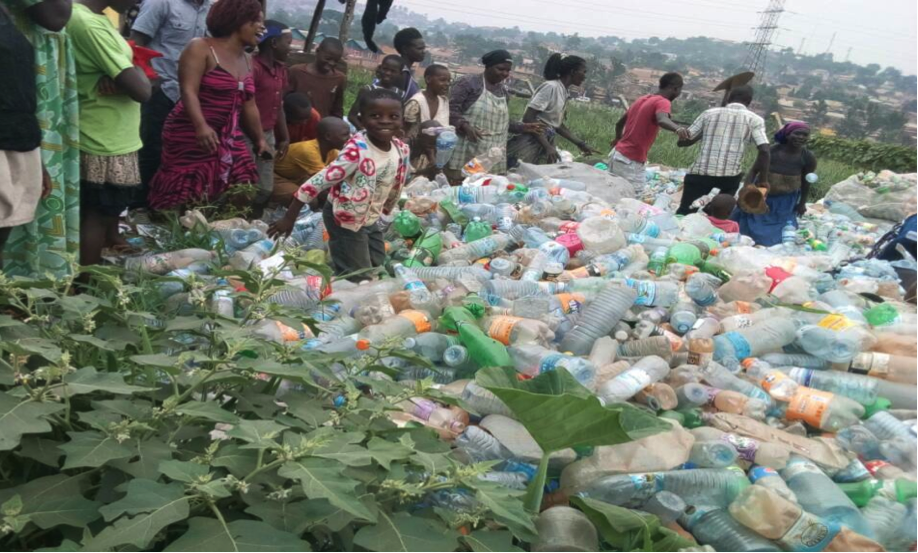
Walking through the slum-like-squatted area of Kampala, the smell of burning plastics and the dust being kicked up by school aged kids reminded me of my former missions with Save the Children and Médecins Sans Frontières; Something I wasn’t expecting which brought both a sense of familiarity and discomfort. Yet, arriving to the bright, warm and safe space which is ECOaction, and hearing the music, seeing the dancing, I felt right at home! Reagan welcomed us wholeheartedly as we arrived; Mia, Anthony, Alex, Vincent, Richard and I. Reagan, as accurately reflected in his projects, is an energetic, warm and a colourful character.
Sitting in a room, one constructed by the community of recycled bottles, Reagan facilitated an introduction to SFA, SFA’s partners and introductions were conducted around this room. We met with Nilotika Cultral Ensemble, who performed for SFA partners alongside the community’s youth. Nilotika Cultural Ensemble shared their experiences of working with Western Organisations, and one member shared the challenges he endured during his previous partnerships with a quote ‘I am asked to sign at the expense of my culture’, that the financial stipulations by Western funding bodies allow for little/no autonomy for African partners. Being in this space as a University of Glasgow representative, an institution who have historically wholeheartedly embodied these extractive partnerships, I was faced with discomfort, but also the realisation that these partnerships must change: That there is a lot of work to do in building both trust and real relationships. There were countless examples of these damaged power relations throughout the three day visit which I experienced, and will continue to reflect and learn from.
The evening was spent conducting ‘strategic planning’ with key stakeholders at ECOaction. More will be shared come on this in the coming months!
Thursday 17th May: 32 Degrees East
Another cool, colourful and creative space in Kampala, SFA Partner 32 Degrees East is a multi-purpose resource centre including hosting artist in residence, meeting centres and art studios. Mia and Is final day, Thursday, was spent on future planning. What future research projects is SFA going to undertake next? What funding is best suited? What partners will be involved? Anthony and I, the SFA Glasgow and Uganda research administrators, created communications strategies and Impact toolkits for the research hubs.
Mia and I finished the day sitting by Victoria Lake with Richard, Alex, Twine, Reagan and Arnold conducting ‘Knowledge Exchange’ on ‘how to take the perfect selfie’


TEDx Reflections: HOW CAN I CONTRIBUTE TO SUSTAINABLE COMMUNITY DEVELOPMENT?
by Julia Diachkova, SFA Volunteer
There are many ways I can contribute to the sustainable development of the community I live in– I can give money, I can volunteer, I can give away stuff I don't use, I can consume rationally, I can support local production, I can recycle, I can litter less, I can be a better person than I am now, be more considerate & less detached. I can remember the world is a shared space, and if I want to be happy with my surroundings, I should begin with my own practice.
What I've learned recently is that people can do more than they think. And they actually do. It is not about superpower or empowerment, neither it is about rights and opportunities. It's about personal values and relatedness. I've learned that people are actually willing to help beyond the walls of their own households, neighborhoods, and cities. Not only ‘willing’ … but taking action. And this was one of my most valuable discoveries as of recent.
Reflections from TEDx
Ignorant as it might seem, up to a particular moment I questioned people's altruistic intentions to help. I thought only professionally-involved individuals would seriously consider and try to tackle the social and ecological catastrophe the divided world was drowned in. All the more important it was for me to learn how wrong I was; the recent TEDx made me #rethink that previous perception of mine.
It was the first time I took part in such a sort of event. Truth to be told, I didn't expect to see many people willing to discuss sustainable development issues, especially those unrelated to their own country, never mind sustainability issues in countries as far away as Africa. Imagine my surprise (and embarrassment) when as soon as the event kicked off I realized that our team of four SFA partners struggled to handle the flow of participants willing to talk. And it wasn't idle talks of drop-in visitors, those people were great: knowledgeable, passionate, involved, experienced, curious; they were sharing ideas and insights, telling about their own projects and those of their friends, challenging our approach and inquiring on how to get involved. They were not indifferent
Looking through the sustainability initiatives that were suggested by Tedx delegates, I noticed that quite a number shared a distinctive feature-: use less plastic, eat seasonal food, consume rationally. All of a sudden the suggestions stand became a resolution board - what each of us can do differently, how each can change the behavior or attitude to improve the personal settings. And it all looked familiar.
'Doing Things Differently'
Here in SFA, members say the goal of the network is to ‘do things differently’ to promote sustainable development. From what I've noticed, this «Do Differently» stands for getting actual results through the work is done; results relevant to the community we're working with, results that address the needs of local people. The team is diverse, in age, geography, spheres of expertise, however, again from what I've noticed, apart from professionalism, they share this "It concerns me" approach. Just like those participants at TEDx. And that, I believe, makes all the difference – when people decide to take action, willing to make whatever contribution they can. When it begins with oneself, rethinking the habitual course of life, the desired results are just a matter of time.

Art and Development walking hand in hand
by Stewart Paul
I was fortunate to be amongst those who helped organize and participate at the workshop on “Exploring the role of Arts in Development Projects” held in Lilongwe at the beautiful Child Legacy International premises on 17th of January this year. As part of the Sustainable Futures in Africa (SFA) network, this workshop was amongst the many activities done in Uganda, Malawi, Botswana and Nigeria where SFA members are based. For Malawi, I felt it was high time that artists and development practitioners work together on sustainability issues. This will help them to think out-of-the-box and come up with new and creative ideas to solve sustainability challenges. As part of Abundance, I attended the workshop with Abundance’s Director, Ruth Mumba and felt that it was very well organized and participants appreciated this endeavor. Initially, we had no clue what the workshop outcomes would be as it was such a novel concept. But after the workshop ended and when we reflected on it, we have realized that it was indeed an enriching experience.
Elson Kambalu, a visual artist who is also a film-maker introduced the workshop and talked about the need for artists and other partners in the development sector to work together and he explained his plan to produce a documentary of the workshop for the next SFA meeting which was to be held in Lagos, Nigeria. The ice-breaker session was interesting and Sharon Kalima got the participants to play games and get to know each other. I had a chance to present about the SFA network and share some views from the SFA meeting I attended in Botswana last year.
Helen Todd of Arts and Global Health Center Africa (ArtGlo) introduced the World Café method of participants working together and developing ideas. We all sat in mixed groups of artists, development practitioners and academicians and brainstormed on sustainability topics and how arts can play a role in such work. Some of the ideas that emanated were that Government should incorporate arts into basic education, introduce more art trainings and provide funds to artists. Organizations must include art through engaging creativity of artists into development projects, we felt.
One challenge discussed was that of how art could solve ecological and social challenges Malawi faces. Solutions aired by participants were many including composing traffic jingles for civic education, imparting knowledge through art on cultural heritage and importance of ecological sites, documenting cultural art and disseminating it through libraries, etc. Overall, participants agreed that artists must be included right from inception of any project, after all art is close to people and people can relate to art. We must promote arts as a platform for discussion of development issues. Local songs, dramas and creative messages can help advocate for sustainability issues such as promotion of renewable energy.
Ruth Mumba got a chance to present about Abundance’s work and Helen Todd presented about how ArtGlo had successfully incorporated art into development projects in Malawi. The participants were treated to a tour of the Child Legacy International premises which is a sustainably-built center. On our way back to our homes, we all felt that we made new friends and learnt a lot. I hope this is just a starting point and a lot of projects can be generated from the ideas generated from this workshop.

After Lagos: Reflections and New Horizons in the SFA
The line between the personal and the professional is one that is more defined for some than others - what we feel versus what we think, what we love versus what we do. The line between the past and future is also held (in the present moment) differently from person to person. For some, the present is contingent on the past, seen through the eyes of, and felt through the experiences of, the past. For others, the present is made up of what is seen around you now; and is a stance that is looking towards the future, able to see it best if looking directly at it, with one’s back to the past. As I reflect on my work in international contexts, with development and sustainability related projects and partners, and in particular with my colleagues across the Sustainable Futures in Africa Network over the past weeks and years, I realise that those lines between personal and professional, and between past and future, become ever harder to make out, ever more slippery. My personal, my history and inheritance, my instincts and emotions, my profession and my expertise seem entirely entangled. It is with this recognition that I share the following statement, taken in part from an opening address to our recent symposium, and in part from a period of reflection in the immediate aftermath.

Panel Event: Moving towards a new approach to development-related research
From the 26th to the 28th March 2018 the Sustainable Futures in Africa Hub Coordinators and Administrators from Scotland, Malawi, Nigeria and Botswana met at the University of Glasgow.
The following items were on the agenda:
- Successes and Challenges of running the administration/infrastructure of the SFA Network Hubs
- Open Panel Presentation at the University of Glasgow
- Harmonization of Administrative Structures of the Network
- Strategic Needs and Direction for the Network
For more information you can read the report: Report SFA Hub Coordinators and Administrator Meeting April 2018

- SFA Hub Coordinators and Administrators, University of Glasgow April 2018
Panel presentation
Sustainable Futures in Africa: Moving towards a new approach to development-related research
The Sustainable Futures in Africa (SFA) Network brings together researchers, practitioners, and communities from the Global North and Global South in one platform for learning, partnerships, and new approaches to research and development. Network hub coordinators from Malawi, Nigeria, Uganda, and Botswana join us for a panel discussion on the evolving practices of the SFA. In particular, the presentations and discussion will revolve around the challenges and possibilities of working across differences of discipline, sector, and geography. We promise a lively discussion, open to many perspectives, contexts, and questions.
- Date: Monday 26th March
- Time: 1pm – 4:30pm
- Location: Level 5 Sir Alwyn Williams Building
- Registation: https://www.eventbrite.co.uk/e/sf-in-africamoving-towards-a-new-approach-to-development-related-research-tickets-43985465712



TRENDS2017 | Between Cities and the Rural: The Role of Universities in Developing our Societies
Reflection on Conference Attendance
Conference Name: TRENDS2017
Location & Date: Pretoria, South Africa – October 17-19 2017
Paper Presented: A Cross-disciplinary Approach to Locating Human Wildlife Interaction in the Mmadinare Region of Botswana
Authors: Modise OM. Lekoko RN , Thakadu O & Mpotokwane M.; University of Botswana
Presenters: Profs. Modise & Lekoko
TRENDS2017 marked the 14th year of PASCAL International conference and the first to be held in South Africa. The theme of the conference was Between Cities and the Rural: The Role of Universities in Developing our Societies. Team Botswana was particularly attracted to the conferences strands that weaved around important areas of (i) the role of nation state versus the global economic power (ii) Cities would be like countries with global power and (iii) Rethinking the role of universities. The theme of interest for the Botswana team was the third strand because it wanted participants to dialogue about and gauge the present and future responsibilities of universities in collaborating with communities to address community or national development. Botswana’s paper on human-wildlife interactions fitted well in this strand calling universities to team up with communities to address local challenges using traditional community approaches such as Kgotla and story-telling thus connecting ‘with the old and modern African tradition’, as was one main theme of the conference. Proceedings were thus tailored to take a form of everyday life consultation and dialogue as used in “the Kgotla or Lekgotla in Botswana and South Africa”(TRENDS2017). To this respect, our paper was able to bring unique practical perspectives on the importance of using traditional indigenous community practices in dealing with human-wildlife conflict.
The paper we presented was enlightening, shedding light on how universities can make themselves valued by the communities. Like the Sustainable Futures Network, the Pascal 2017 Pretoria Statement stated that “Pascal’s Learning City Network must be sustained in order to provide a platform for inter-cultural, inter-disciplinary and international exchange between cities/regions”. It unpacked how worldwide perspectives generated through research in universities could be prolifically applied on local possibilities. This we believe echoes the sentiments expressed by the Sustainable Futures Network.
Our paper attracted constructive feedback:
Suggestions for improvement
Explore in detailed elephants migration routes
- Correlation analysis and comparison with experiences elsewhere may add value
- A broader geographical sampling (within Botswana) may be considered to allow comparison
- Construct a robust sampling of study site
- Collect more publicly available data e.g. through informal discussion of the villagers.
Commendation
- The use of familiar and non-traditional research techniques like community forum (Kgotla) and story-telling
- Cultural sensitivity of respecting community leaders (Dikgosi & elders) as principal investigators
- Approaching the study with an interdisciplinary/multidisciplinary mind-set and respect for community members
- Robust data selection and analysis to bring out what conflict meant for the villagers
- Presenting the interviews with more authority from the voices of community members
With all these comments our study will continue to improve and advance into a more holistic exploration of this challenge of human-wildlife conflict.
The Research Team in Botswana would like to appreciate the support and thank Mia Perry (coordinator of University Court of University of Glasgow - Economic and Social Research Council (ESRC) for this opportunity to present at TRENDS2017 conference, which in our opinion is a giant step on a journey to Building Connections for Sustainable Futures in Africa.
The comments given will be taken into consideration as the research advances.
For more information please visit: http://pascalobservatory.org/ & http://cradall.org/resources/links/pascal-international-observatory

Tweets by obspascal https://platform.twitter.com/widgets.js

At Home with Social Science: SFA visits IKEA
The University of Glasgow hosted its College of Social Sciences Research Fair. As part of this, the Sustainable Futures in Africa team took part in their public engagement event at IKEA.
Written by SFA Intern and Ph.D. Candidate Samir Halliru
It was a great day at IKEA on Saturday the 4th of November 2017! The SFA team arrived at the venue at 8 am with the hopes of fruitful interaction with members of the public! After safety briefings, the SFA team displayed African costumes to reflect the regional focus and our interdisciplinary work. Two activities were conducted on the day; a multiple-choice quiz and a ‘Hans Haacke’ style voting poll, see below

- How Can We Best Help Global Inequality: ‘Hans Haacke’ voting poll
Perceptions of the event
‘It was really pleasing to see grannies, parents, and children really engaging in the activities you put on. I saw proud parents standing watching as their children showed off their knowledge of ‘what makes you healthy’, and of the barriers to inclusion and a range of literacies. - Professor Sally Wyke
Samir outlined how the event has triggered public curiosity and interest in the universities taking research outside the university through engagement with the actual beneficiaries (people) of the university researches. Events like these are some of the best ways to address social inequalities at the local, national and global levels.
Dr. Daniel Koehn shared that 'It was surprisingly rewarding to talk to the variety of people wandering by, to answer their questions and to send groups of people off chatting and debating about charities and Africa. It was essential that Nigerian SFA Intern, Samir was there; otherwise, it’s just white people talking about Africa, which would not be very authentic.'

- Dr Daniel Koehn, UofG getting involved in the SFA Quiz
The trend of international development in the global south
People were interested, especially those with connections to the Global South through travel, jobs in the third sector and research. It was easier than I expected to engage people. For example, Molly reported the stories of two young students who shared and discussed their experiences of completing research in Uganda. It seems to the BA students who conducted the research that the development research seemed to benefit the Northern students more than the communities they researched.
One participant in the events reflected that to solve the issue of international development in the global south powerful countries should organize to dredge the surrounding sea and channel all the water to Africa – ‘there’s lots of water in the sea, and Africans need water – simple?!’
What should be done differently?
There were many ‘take homes’ and lessons learned, as this event served as a great ‘test-run’ for future events. For example, it was noted that there wasn’t a focus on the Global North’s role in International Development; I would like our local public engagement events to focus more on this in future events.
‘Rather than “curiosities” of the global south, I would like a stronger emphasis on our explicit roles and connections with the global conditions of inequality and plurality’ – Dr. Mia Perry.
Daniel noted that that the question for the bowl could have been selected better as the question confused people and there was a danger of leading people to our preferred answers through our explanation. The issues it seemed to raise for many people was the management of charity funding, rather than our own day-to-day lives and choices and their role in the overall global state of inequality. The following suggestions were noted for future events:
- A different question is needed – and this day was a very good way to develop an understanding of common perceptions and views;
- More interactive activities for the next event to gather more insights into people’s perfections
- The quiz was very successful yet we could create questions directly with the projects we are involved in;
- Storytelling would be a nice approach in the future, small movies made from the scoping trials. This could be an output from our new arts-based projects
- We need a hand out with the website URL, and some key images and information on the network. Leaflets will be of great help in future events
To Summarise …
IKEA is a big multinational company that designs and sells ready-to-assemble furniture, kitchen appliances, and home accessories. IKEA in Braehead (Glasgow) was believed to have 8000 to 13000 people going through their doors every Saturday. The choice of the location for the University of Glasgow's College of Social Sciences Research Fair offered a great opportunity for listening to people’s voices and perceptions of international development. As noted by Molly a conservative estimate is that we reached 800 of them with our activities on the importance of social science and what we can offer. I think similar events might be good in partner countries: Uganda, Botswana, Nigeria and Malawi. Engaging the public through market places and festive events will offer great perspectives on the people's needs and concerns.
For More information: https://www.gla.ac.uk/colleges/socialsciences/research/esrcfestivalofsocialscience/festival2017/

- A Storyboard of Uganda's Research Trial

Scotland-Malawi Partnership: Further and Higher Education Forum
On Wednesday 20th September the Scotland Malawi Partner’s Further and Higher Education Forum met at the Edinburgh City Chambers. Here Dr Mia Perry shared the work that The Sustainable Futures in Africa Network is doing in Malawi including how both academics and NGOs from Malawi form part of this Network that is building capacity, infrastructure and research in socio-ecological sustainability in Africa. Dr Perry also represented colleagues from the University of Glasgow and shared information relating to MALBOP: Malawi – Biology of Parasitology, a interdisciplinary team based at the Institute of Infection, Immunity and Inflammation at the University of Glasgow. Their synergy arises from open flow of information and ideas, from high quality of training, and from close involvement in research communities in both the developed North and the developing South.

Attendees Included:
- Susan Flynn and Akuzike Kamwanja, Chifundo UK and Chanasa Malawi - Malawi Tuition Fees and funding for female university scholarships at public-funded universities in Malawi
- Mia Perry, University of Glasgow - The Sustainable Futures in Africa Network; MALBOP: Malawi – Biology of Parasitology
- Carol Clements, University of Strathclyde - IMMPAQKT: Impact on Malaria, Maternal health and the Prognosis for Aids by Quality Assurance
- Julie Struthers, University of St. Andrews - Enhancing Medical & Healthcare Training; Strengthening IT Capacity
- Alistair Tough, University of Glasgow - Health information management and medical record keeping systems in Malawi – a preliminary investigation
- Karl Magee, University of Stirling - The Peter Mackay Archive Project
Dr Perry described the event: “An interesting group of experienced scholars, practitioners, and stakeholders with long ties and connections, both personally and professionally in most cases, with Malawi. The delegates on this occasion were primarily rooted in health sciences, and discussion was largely focused on contributing aid, equipment, programme development to Malawi. Little conversation or project content related to a reciprocal relationship, except for that of cultural and historical ties. In contrast to many international development related networks, the historical and cultural connections of Scotland and Malawi are palpable in this community”
Now Mia Perry updating on a variety of Malawi links @UofGlasgow including #MALBOP2017 @WCMPGLASGOW @ScotlandMalawi
— Colin Reilly (@ColinFReilly) September 20, 2017
https://www.youtube.com/watch?v=KBg06kOiHrE
For more information about the Scotland Malawi Partnership, visit: https://www.scotland-malawipartnership.org/
For more information about our partner Abundance, in Malawi - http://abundanceworldwide.weebly.com/malawi.html.
For more information about MALBOP: http://www.gla.ac.uk/researchinstitutes/iii/wtcmp/wellcometrustcentreforglobalhealthresearch/

Reproductive Health at Mbando Village: Dispelling Myths
Making informed choices regarding reproductive health is something that is taken for granted in developed countries with good access to health services. This is often not the case in developing countries, and particularly so at Mbando village which is located by the shores of Lake Chilwa, in Machinga District, southern Malawi. Being one of the poorest countries in the world, Malawi faces a number of challenges, including poor access to reproductive health services and inadequate awareness. Mbando is a small village with 95 households consisting of mostly subsistence farmers and fishermen. It is vulnerable due to being prone to droughts and having few livelihood options. However, there is a vibrant youth community at the village. They have organized themselves into a club called “Wonderful Youth Club”. Being concerned about the high number of teenage pregnancies and many misconceptions regarding reproductive health, this club requested Abundance to hold a training session to discuss sexual and reproductive health.
Stewart Paul, Secretary of Abundance and a person of multiple talents, offered to undertake the training and was the right choice, being a youth himself (22 years old). On the 22nd of July 2017, Stewart joined Ruth Mumba (Director of Abundance) and others to Mbando village to meet with the youth to discuss this important yet often neglected topic. The youth face many challenges including poor access to contraceptives. They said that the nearest clinic was 3 km away and contraceptives were often unavailable and when it is available they were distributed to more established youth clubs in surrounding villages. Youth could not access any “counselling” or knowledge on sexual and reproductive health. Often girls were uncomfortable approaching older women to request for contraceptives at the clinic because they feared being judged immoral.

- Stewart Paul talks to the youth, as Ruth Mumba (left) looks on.
It was surprising for Stewart to hear about the myths and misconceptions regarding this topic from the youth:
“Artificial contraception methods lead such as using pills lead to sterility or infertility.”
“When boys use contraception, over a given period of time they lack sexual prowess and stamina”.
Through the training Stewart dispelled some of the myths and provided much needed information to youth about sexual and reproductive health and how contraceptives work. The need for family planning was emphasized and he explained that good sexual and reproductive health is a state of complete physical, mental and social well-being in all matters relating to the reproductive system. The importance of taking care of the reproductive system to avoid injuries and infection was also emphasized.
The session was only for a few hours and the youth requested for more such sessions to be organized for continued awareness raising on these matters. The access to contraceptives remains a challenge to be overcome. Abundance hopes to collaborate with organizations that provide these services and work towards improving access for youth at Mbando village. We envision a Malawi where all youth will be free to take informed decisions regarding reproductive health. This training was a small step towards that vision, but many more needs to be taken.
For more information visit: http://www.abundanceworldwide.org
 @abundanceworldwide
 @Abundance_ww