
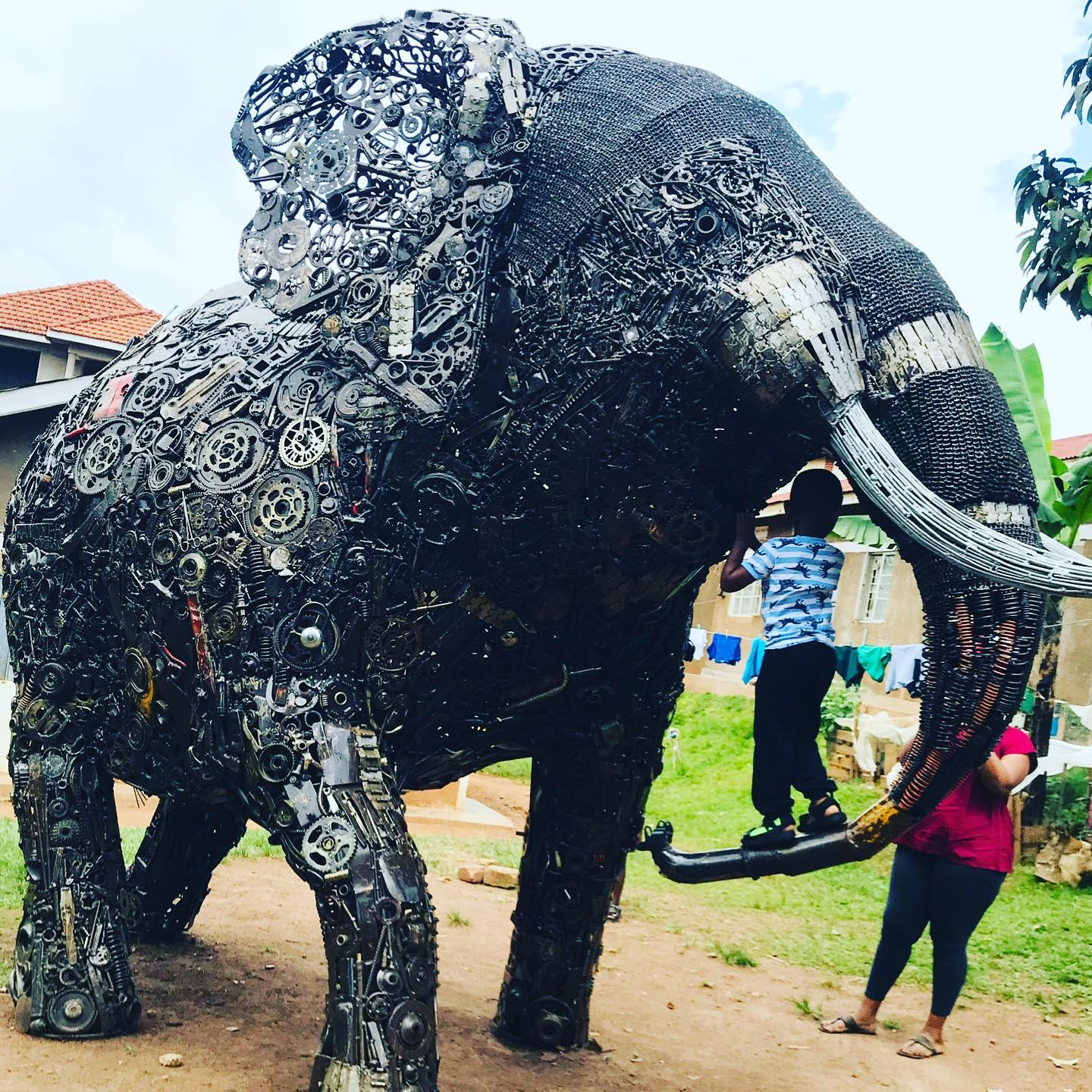
Social Arts for sustainable community partnerships - activism, research and education
Archives Units
Welcome to the unit Social Arts for sustainable community partnerships - activism, research and education.
This unit begins with an exploration of art as a primary need, working with the raw materials of the world to make and re-make, to explore and inquire, to present and represent.
Arts experts (artists, researchers, and educators) from Africa, North America, and Europe will work with you to share and explore the practices of craft, play, creation, representation, collaboration, and imagination. The course will expand the notion of the arts as entertainment and as illustration; and engage with arts as critical contemporary research and learning practices. As a group, the cohort will address using culturally relevant arts to engage people, to educate, and to research.
Creative practices, ways of being, knowing and doing are ever more critical in a world that is in unprecedented environmental fragility, and a moment of exasperated global social upheaval.
The sub-units aim to equip participants with the knowledge, place-based practices and pedagogical strategies necessary to integrate ecological awareness, Indigenous and local perspectives and sustainability with the arts as a way to uplift and weave together notions of artistic creation, inquiry, and learning. By emphasising local relevance and global context, the course fosters a relational approach to arts practices that relies upon dialogue and collaboration to bring about ethical partnerships of action.

Intended Learning Outcomes (ILOs)
By the end of the course, learners will be able to:
- Understand the diverse purposes and practices of art as imagination, expression, livelihood, and world-making.
- Explore how the arts can serve as powerful tools for activism, advocacy, and community engagement.
- Apply artistic methods to educational contexts, fostering creativity, play, and inclusive learning.
- Design and implement culturally responsive, arts-based approaches for inquiry, participation, and knowledge sharing.
- Reflect on their learning journey to identify personal goals, future collaborations, and sustainable pathways for continued creative practice.


Whose Voice Counts? Ethical Participation for Decision-Making
Archives Units
Welcome to the unit Whose Voice Counts? Ethical Participation for Decision-Making.
Too often, participation is treated as a one-off step in a project cycle—design, implement, evaluate. This course offers something different: a space to explore how engagement can be continuous, inclusive, and transformative. Instead of treating stakeholders as subjects of research or consultation, we invite you to practice ways of working where they become genuine partners in shaping outcomes.
Our focus is on the thickness of engagement—the depth, diversity, and inclusivity that make participation ethical and impactful. Over four interactive online sessions, you will experiment with multiple forms of engagement, test out new ideas in a safe and supportive environment, and reflect on what works best in your own context. Together we will combine learning, application, and reflection, culminating in participant-led presentations where you will activate this knowledge and plan how to embed it in your own institutions or programs.
Intended Learning Outcomes (ILOs)
Through this unit, learners will:
- Explore concepts central to participation;
- Learn from experts from different contexts ans sectors;
- Experiment with practices that can transform engagement, partnerships, and outcomes in deliberative processes;
- Learn as a community of practice, through discussions, activities, reflections and evaluation.
- Walk away with practical tools, fresh insights, and the confidence to put ethical participation into action – moving beyond checkboxes toward meaningful change.
Pluriversal Literacies for Sustainable Futures
Archives Units
Welcome to the unit Pluriversal Literacies for Sustainable Futures
This unit invites educators to expand their understanding of literacy as more than reading and writing skills. Literacies are explored as relational, place-based, and sustainability-focused practices that connect learners to their communities, environments, and multiple ways of knowing. The framework of the pluriverse guides this exploration.
Intended Learning Outcomes (ILOs)
At the end of this unit, you will be skilled to:
- Explain literacies as relational, place-based, and sustainability-focused practices;
- Describe the pluriverse as a conceptual framework for education;
- Critically reflect on the limitations of Eurocentric approaches to literacy;
- Identify and integrate multiple knowledge systems (Indigenous, community-based, local) into literacy teaching.

7. Project
Welcome to the unit Project
By now, you should have acquired substantial knowledge about the diverse range of natural resources and their significance in contemporary society. We have delved into sustainable approaches to engage with these resources. Your ability to assess the impact of natural resource projects in different countries and understanding their potential advantages and disadvantages for both the environment and local communities, should be well-developed.
The insights gained from the initial three chapters should enhance your understanding not only of how to interact with nature but also of how to effectively engage with individuals whose futures are intertwined with a thriving ecosystem. Recognizing and respecting the needs and preferences of local communities are crucial for establishing enduring relationships, fostering strong connections, and building sustainable partnerships.
Furthermore, your expertise in the geology of metallic ore deposits, water, soil, and land use positions you advantageously in comprehending how to interact with diverse natural resources while ensuring their secure extraction. When engaging with these resources, you’ll consistently be mindful of potential adverse effects, such as pollution, that could impact the environment and its inhabitants.
Your proficiency across these facets positions makes you an expert in the sustainable interaction with natural resources. Consequently, you will apply this knowledge in a final project.

Intended Learning Outcomes (ILOs)
In this unit, you will be able to:
- effectively solve conflicts and come to a conclusion where all parties are satisied.
- Apply all the sklills you’ve learned so far in this course to a solve a realistic problem.
- find creative ideas on finding your own approaches to handle ressources in a sustainable way.
- find a way to include local societies in your projects to achieve a long lasting connection.
Project: Mining rare earth elements (REE) in Australia
You are the CEO of a mining company, which is specialized in the extraction of rare earth elements (REE). As REE are crucial for achieving the energy transition, the goal of your company is to extract these desperately needed commodities as sustainable as possible.
Your senior exploration geologist has informed you about several promising REE deposit prospects located in western Australia. Unfortunately the majority of them are located on lands which are exclusively in the possession of native Australian communities. These native reserves are home of an aboriginal tribe. Members of the tribe have heared rumors about potential mining projects within their territories and see the opening of a mine very critical. They are concerned about the negative impacts these projects could have on their land and ecosystem. They are concerned that REE-mines in this area could potentially pollute the ground water which is a precious ressource in these arid regions and already quite scarce. Not only does the mining project potentially pollute the ground water, but also consume a lot of water what could result in a water conflict with the Aboriginies. A lack of water supply would have drastic impacts on agriculture and livestock farming, not to mention the lack of clean drinking water. Furthermore, the tribes are concerned about what happens to the mine after the exhaustion of the deposit? Will there be just a “hole in the ground” which leaves the landscape of this beautiful native reserve scarred?
Even though the chief of the affected aboriginal tribe has major concerns about your mining project, he is willing to listen to your proposals and arguments. He hopes that you will together find a way how both parties could benefit from a project like this and how the impact on nature can be reduced to a minimum.
Your task will be to write a proposal, which is adressed to the aboriginal tribe as well as the Government of Western Australia where you will formulate your approach on opening a REE mine in a native aboriginal reserve. In this proposal you will:
- Explain what kind of REE-hosting mineral deposits can be found in Western Australia, which important REE can be found and in which abundance. Furthermore you need to briefly explain what these REE can be used for. Use the following website which will help you with these tasks: https://www.ga.gov.au/scientific-topics/minerals/mineral-resources-and-advice/australian-resource-reviews/rare-earth-elements
- Illustrate how the negative impacts of REE-mines on nature and the local ecosystem can be minimized. Also, you will deal with the concerns raised by the tribe about the scarcity of groundwater, its pollution and other environmental issues.
- Come up with a plan on how to intigrate the Aboriginies in your project for a mutual and long lasting benefit for your company and the local community.
- Design a recultivation plan where you describe what will happen to the mine after the cessation of the mining project. How do you plan to renaturate the mining area?
Please write 3-5 pages for this project.


6. Resources: Soil and Land Use
Archives Units
Welcome to the unit Resources: Soil and Land Use
This unit aims to introduce the participants to the concepts and principles of sustainable land use.
Previous units covered the use of critical elements and water. Both resources are tightly bonded with the soil they are attached to. Extracting mineral resources influences the surrounding heavily, both soil and water. Necessary for mining is water. The resulting waste waters have the power to pollute the environment, as they are usually enriched in heavy metals. Similarly, ore processing bears risks. After breaking the mined material down in size, the ore is processed with chemical treatments, for example cyanides when processing gold ore. Leakages of waste water are devastating for the environment and restauration is expensive and long-lasting.
This unit provides a wide spectrum of soil-related topics. The methods of land use are a driving factor for human development during the last 12,000 years and often combined with new technology. Providing fundamental knowledge about soil formation and restoration will create awareness for its value. The following unit covers the threats posed by human activity and climate change. This information is adjusted with considerations about responsible land use in advance for economic interests on one side and environmental sustainability on the other.
The main objectives to this unit are:
- Introducing the participants to fundamental understanding of the formation of soil and its value across local, regional and global scales
- Understanding the variety of threats posed by human activity and climate change
- Providing a wide range of measures to protect this resource
Intended Learning Outcomes (ILOs)
By the end of this unit, you should be able to accomplish the following tasks:
- To learn about the change of land use through time and what caused these changes
- To understand and explain basic soil classes and the main concepts of pedology and edaphology
- To know about forms of soil pollution and acidification.
- To reflect and discuss on the state of soil in their country and its influence on society
- To understand the interplay between human impact on environment and environmental impact on humans
- To reflect about the impact of land use on society and culture

5. Resources: Water
Archives Units
Welcome to the unit Resources: Water
The unit is intended to introduce students to the concepts, and principles of sustainable water utilization, and introduce some of the threats which tend to counteract the sustainable availability of potable water not only for domestic and industrial use, but also for maintenance of a healthy environment throughout the industrialized economies of the world as well as developing regions of the world.
The unit of necessity is very practically orientated. Therefore, an appreciable amount of time will need to be spent identifying the basic principles and finding solutions that match the context of the problem (NB The aim of the unit is NOT to train hydrologists, but to identify practical solutions to problems threatening sustained potable water. The detail in the unit will need to acknowledge this context). The unit traces water on the earth by dividing it into the main components & acknowledging that, at present, desalination of sea water is not a viable option. This logically leads to the hydrological cycle and the dominant forcing factors governing the quality and quantity of water. These are then considered individually in terms of their characteristics, and the threats posed by human activity while still giving due consideration to the need for economic and industrial advances to continue at the local, regional and national scales.
The unit considers what potential impact is associated with the range of human-induced problems and activities, emphasizing again the concept of cost – benefit analysis in which the environment (clean water) AND labour and economic wellbeing are included. The impacts of the same list of elemental ores used in the mineral & mining resources sub-units will be considered, and how these impacts may be similar (or different) in the four partner countries. These are: Cu; Co; Ti; Fe; Si; Sn; Li and Al, as well as stone, aggregate, oil and coal.
The spatial nature of these problems at the local and region impact level will be interrogated using GIS, RS and geological maps.
The main objectives of this unit are:
- To introduce students to a fundamental understanding of the distribution of water as a limited resource across local, regional and national/international frontiers;
- To understand the water cycle and to understand the threats posed by many of the activities we take for granted, in particular domestic supply, agriculture and mining activities; and
- To focus on the environmental context of water as a limited resource in need of conservation and management that is steeped in modern technology, as water availability and quality is increasingly presenting limits to further economic and industrial development
Intended Learning Outcomes (ILOs)
In this unit, you will be able to
- To discuss the implications of water as a resource, and the range of environmentally compatible technologies available to safeguard it;
- To understand some of the complexities around the distribution and abundance/scarcity of water, and to view the environment as an equal, necessary consumer of water as an essential resource,
- To be able to make decision that take cognisance of the threats and challenges posed by global climate change and variability to the water sector; and
- To be able to contribute significantly to project planning initiatives, and to understand the water conservation needs as an integral part (rather than an add-on) in all development projects.
You should therefore be able to:
- Appreciate the importance and complexity of water as a resource, and the need to use it in sustainable ways;
- List the main threats facing water as a finite, limited world resource
- Summarize the main factors and processes influencing the water cycle and to describe their inter-connectivity and feedback mechanisms;
- Describe and account for the main sources and limitations to fresh water in different regions on earth, and how this is likely to vary in space and time within the context of global climate change and variability;
- To be familiar with the principals, processes and consequences for both natural and human-induced degradation of water quality, and to recognize when intervention/rehabilitation is necessary, and
To understand and describe the common causes that may result in the pollution of water, as well as the consequences and potential rehabilitation strategies required.
Please Note
Students may add to these notes by addition reading, both from library based literature, as well as that found in scientific journals, whether in print or on-line. It is also useful to keep up to date with material offered by Google-Scholar. It is important to differentiate this refereed site from the standard internet sites, which are free-to-post. This means that opinions, rather than facts are published; irrespective of whether they are substantiated or not.

3. Community interaction and its relation to material resource
Archives Units
Welcome to the unit Community interaction and its relation to material resource
This unit explores our individual and collective motivations for engaging with community and the impact those motivations can have on our experience and support for sustainable development. This unit also provides some general considerations and guidance regarding community engagement. When we get engaged with the community, we get to learn from them. Local knowledge is instrumental in supporting sustainable development.
Intended Learning Outcomes (ILOs)
In this unit, you will be able to
- Articulate your own motivations for and understanding of community engagement
- Analyze how one’s approach to community engagement can impact the community
- Compare various principles of community engagement
- Relate community engagement to community learning for sustainable development

2. Ethical Global Partnerships
Archives Units
Welcome to the unit Ethical Global Partnerships
This unit deals with social aspects of resource use and associated problems including global ethical partnerships, stakeholder analysis and the indigenous and community perspectives on resource use.
Intended Learning Outcomes (ILOs)
At the end of the unit,
- you are able to discuss the complexity of ethical partnerships
- you are familiar with a stakeholder analysis
- you understand the indigenous and community perspectives on resource use
- you can critically analyse the difference between these two perspective of utilising natural resources

1. Sustainable Resources and Global Ethical Partnerships Introduction
Archives Units
Welcome to the unit Sustainable Resources and Global Ethical Partnerships Introduction
This unit provides an introduction to natural resources in Uganda, Eswatini, Germany and the UK. In addition, the relationship between humans and natural resources are discussed in detail using a variety of examples. The unit concludes with a short history of natural resources.
Intended Learning Outcomes (ILOs)
At the end of this unit,
- you are familiar with the natural resources in the four countries of this course
- you are able to discuss the relationship between humans and natural resources
- you are able to reflect on the history of natural resources
- you are able to articulate your own relationship with nature
- you are able to compare various worldviews toward nature and natural resources
- you have developed a critical understanding about nature for a sustainable future
- you are able to reflect on resources definitions

4. Resources: Critical Elements
Archives Units
Welcome to the unit Resources: Critical Elements
Critical elements are all around us. They are needed for your mobile phone, your car, computer and tablet and they are fundamental for the so called clean energy transition moving away from fossil fuels. You have learned in Unit 1 that the geopolitical landscape will change dramatically during the transition from fossil fuels to critical elements. What are critical elements and why are they “critical”? An element, mineral or material, is critical if it is a) not easily accessible, b) there are no large resources or the resources are concentrated in one area, c) it depends on locality and how they are mined (sustainability, responsibility, politically)?, d) and whether or not this resource is recyclable. Unfortunately, quite a number of important elements that are used for the clean energy transition and a lot of modern devices are critical. Let’s have a closer look at these elements, discuss their demand and supply, and implications for society and geopolitics.
Intended Learning Outcomes (ILOs)
In this unit, you will be able to
- recognize multiple dimensions of critical elements in society
- develop an understanding of the formation and supply of critical elements, and implications for society and geopolitics
- discuss possible responses in real practice.