
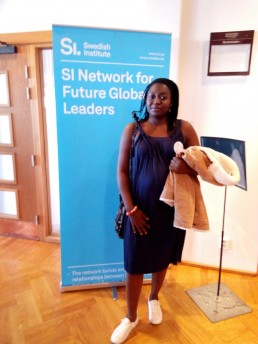
Impact Story – Thank you SFA Network!
By Grace Awosanmi, Research Administrator – Nigerian Hub
I wanted so much to be in a circle of those who were keen in in improving food and agriculture in Nigeria and discovering SFA after an extensive Google search was a blessing. Being in the network with a lot of professionals and reading some of the research and activities that happen within the network was the very key for me in choosing to study Sustainable Development. Understanding sustainability is really something I always desired. It is also an opportunity to tell my class during presentations that Africa too has a lot going on in a bid to achieve goal 2030.
So yes, thank you SFA for allowing me to become an affiliate member, even without knowing any previous member. I also got a Swedish Institute Scholarship to study this course which is a platform that allowed me to share a bit of the work of the Sustainable Futures in Africa Network. I am excited about this journey. I am also the only Nigerian/African in my class (This I believe is a blessing).
Margaret Ojochide Aligbe
The above words came from Margaret during an email conversation. I was thrilled to know that she was now a postgraduate student at Uppsala University in Sweden to study for her Masters’ degree in Sustainable Development. A graduate of Agricultural Economics and Extension with a passion on how to tackle and achieve zero hunger in the Sub-Saharan Africa. She previously worked as an administrator and volunteer with the LAGOS FOOD BANK INITIATIVE (www.lagosfoodbank.org), an NGO committed to reducing hunger in the Nigerian society.
Margaret became an affiliate member of the network last year from Nigeria. I was excited with her inclusion – the Nigeria SFA Hub was expanding. We developed a good relationship around the activities and events that were ongoing in the hub and across our country. At the time she became an affiliate member, the hub was engrossed in engagements with the mining communities, so a right hand of fellowship was extended to her to join in one of our trips. Unfortunately, she couldn’t join our team for recent field trips, but the communication line remains open. Over the past months, we communicated through emails and she became more interested with the ongoing project activities across the hubs as we conversed. Apparently, the activities and results she was hearing and seeing were inspiring her.
She did not just want to be an Affiliate member but a full fledge member with qualifications and experience which can bring about a productive use in the future. She never stopped looking for ways in which to engage more with the hub and the network. She later informed me that the decision to go for a programme in Sustainable Development came as a result of her going through the profile and the expertise of the members of the hub. Whereas the information gathered and gleaned through the network website also stimulated her interest to focus more on how to make sustainable development goals work for people in Nigeria and Africa as a whole in her study.
From the entire SFA family and the Nigeria hub, we say well-done and congratulations Margaret. We look forward partnering with you for future opportunities.


Interview with SFA Co-Director | Career Changes to Fuel your Passions
By Vanessa Duclos, Network’s Research Manager
Do you sometimes have doubts about your career choices? It is never too late to discover new passions, and to follow the necessary steps to make it a new vocation. While visiting the University of Glasgow in September, Dr Deepa Pullanikkatil, Co-Director of the SFA Network, was interviewed by Emma Smith from DEVEX about why and how she changed her career from civil engineering to environmental sciences, with a focus on climate change adaptation.
https://www.devex.com/news/q-a-how-this-engineer-began-a-new-career-in-global-development-95576

Why Volunteering is so Rewarding
By Ruth Mumba, Director, Abundance, Malawi
I read somewhere, “Volunteers are love personified”. I think that phrase truly defines what volunteering is. It’s a service beyond self. A journey that cannot be summed up in financial terms but with immeasurable returns. My volunteering journey led me to be part of the Mandela Washington Fellowship 2019. The Mandela Washington Fellowship for Young African Leaders, which began in 2014, is the flagship program of the Young African Leaders Initiative (YALI) that empowers young people through academic coursework, leadership training, and networking. The Fellowship provides outstanding young leaders from Sub- Saharan Africa with the opportunity to hone their skills at a U.S. college or university with support for professional development after they return back to their home countries. Fellows engage in Academic and Leadership Institutes, meet with U.S. federal, state, and local government officials, participate in community service, visit organizations to gain professional development, and make friendships and professional contacts with Americans.
I have been volunteering since I was 17 years old. But I never imagined how key volunteering would be for my life. Back then, I did it to get enough credit hours in order to graduate high school. When I got to university, I paid more attention to why I was volunteering. I realised I did it to help other people to see a different perspective to life. We would go to a rural village every Saturday morning to teach children early childhood development skills. We played games, sang songs and had discussions on various aspects of life like education and the importance of good health. I felt so fulfilled in those few hours I spent with the children and got a new energy for the new week of classes, assignments and lecture hours back at university.
In 2016 I started working with Abundance Worldwide and became part of a larger group of volunteers on a more professional level. Abundance Worldwide is part of the Sustainable Futures in Africa (SFA) and amongst our partners and networks, we have created a platform where we can remotely volunteer and contribute to individual partner projects from activities including website development to grant applications.
There have been days I thought that I was biting more than I could chew. Communities sometimes have expectations far beyond our capability. But by working together, I have experienced an ease doing developmental work. Together, we were able to resolve conflicts in communities, help develop technical skills of the youth and built an E-Learning centre that the whole community has access to. We have engaged student volunteer to teach and mentor their peers in deprived communities.
While in the United States of America, I had a first experience of being an international volunteer, in a developed country! I had a chance to cook for the homeless, went to a farm to harvest produce for a food bank and planted trees at a local park. I realised that the world has the similar problems. We cannot sit back to wait for institutions or governments to fix them. Sometimes, it is up to us, the people, to come together, pull our resources and help those who are unable to.
I believe that one reason I made it into the Mandela Washington fellowship was due to my leadership and volunteering spirit. To see a sustainable future of Africa is to imagine the possibilities and act on it. Volunteers go far and beyond boundaries. This month at Abundance, we are hosting a Volunteer from France, Julie Charmetant. We are sharing notes on our individual volunteering journey. We want to teach, give health related advise, provide financial literacy and many more. Equipped with passion to see change, volunteers can leave a long lasting impact in individuals and communities they work in. We at Abundance are striving to do just that.
About the author
Ruth Mumba is a Geologist with a Bachelor of Science Degree in Earth Sciences and Geography from the University of Malawi, Chancellor College. She has been working for the past five years at the Geological Survey Department under Government of Malawi focusing on geological mapping and geothermal resources exploration. She is a Mandela Washington Fellow (2019) and the Director of a voluntary non-profit organisation, “Abundance” (member of SFA network) which supports a village in southern Malawi using an integrated approach. Her passion is volunteerism and supporting vulnerable communities and works towards supporting communities in Malawi use their natural resources in a sustainable manner, have access to quality education, technologies and health facilities.

From Research Administrator to PhD Student: Impact Story of Anthony Kadoma
Compiled by Deepa Pullanikkatil and David Gerow
It’s been two years since Anthony Kadoma joined Sustainable Futures in Africa. He was initially hired on a four-month contract to work as a research assistant, but through his hard work and intelligence, Anthony has risen from being a short-term Research Administrator to a PhD student at the University of Glasgow, and a valued member of the Sustainable Futures in Africa (SFA) Network. It’s an opportunity he doesn’t take lightly. “I know it is likely not to be a walkover,” he says of his upcoming PhD studies, “but rather hard work that calls for a lot of flexibility and commitment on my part.”
Anthony was originally invited to join SFA in 2017. He was enlisted by Dr. Twine Bananuka, who had been one of his lecturers when he was studying for his BA in Adult and Community Education at Makerere University. Anthony had subsequently earned his master’s degree in Applied Community Change and Peacebuilding at Future Generations University WV USA, which led to work as a consultant in Kampala. At that time, Twine and his colleagues were undertaking a scoping study in Uganda, and they needed someone to manage the enormous amount of audio and pictorial data they’d amassed. They also needed help coordinating their work with colleagues in other hubs of the SFA network. “Dr. Twine was aware of my working ability and skills,” Anthony recalls. “He recommended that I be given the Research Assistant job to assist the hub members in transcribing the data they had collected, organize it, come up with themes and also assist in the writing of draft papers. I was fortunate that the other members believed in him and gave me the job. That is how I joined the family of Sustainable Futures in Africa Network.”
While working with SFA, his immediate supervisor has been Dr. Alex Okot. Anthony describes Alex as “a very good man: approachable, transparent, and he gives me time to discuss network issues even when he is so busy”. Anthony also praises the other hub members he works with on a regular basis, whose “openness and support” he values. “Working with other research assistants and academicians from countries like Nigeria, Botswana, Scotland and Malawi promotes my international exposure,” he says. “This is something that I really enjoy.”
But Anthony’s experience with SFA hasn’t been entirely office-bound. He’s attended two international symposiums – one in Lagos, Nigeria and one in Lira, Uganda – which he even had a hand in organizing. He’s also done a significant amount of fieldwork, an opportunity he values. “I have personally visited communities, interacted with community members and learnt a lot from them: the way they live, how they cope with challenges. I have liked working with organized groups of students, farmers and youth in Alebtong district as they work towards improving their livelihoods. I like the challenge because indeed poverty still persists as a great challenge, and this calls for more training to come up with workable approaches to reduce it today, not in the future.”
Just as he does his part in helping SFA collaborate with communities, Anthony has also reaped personal benefits from his work. Not only does it provide him with a welcome source of income and a network of likeminded colleagues, but it has allowed him to sharpen his digital literacies. “For instance,” he says, “most of our meetings are done on Skype and Zoom, and we chat constantly through WhatsApp and emails, as well as sharing documents using Google docs among others.” He anticipates that these necessary skills will help him as he moves on to his next challenge: a PhD at the University of Glasgow.
His PhD is another opportunity that he traces back to his work with SFA, as it arose through a meeting with SFA co-founder Dr. Mia Perry at the 2018 Lagos symposium. In his conversation with her, he expressed his interest in pursuing a PhD, to which she replied, “Where there’s a will, there’s a way.” Anthony told Mia that he wanted to work on community development, research and youth, and she suggested he send her a project proposal. As Anthony tells it, “She introduced my concept to her colleagues at the University of Glasgow, and by the grace of God it was selected, and that is how I became a PhD student on the study.” He’s about to begin his PhD in Environmental Sustainability, with a problem entitled Understanding the perception of multiple stakeholders of the ecosystem services provided by mangroves to improve restoration activities. He’s eager to seize every opportunity that comes his way: “While at the University of Glasgow, I hope to be intellectually stimulated since I will be living and working with intellectuals. From these people, I hope to get some motivation and courage to push forward.”
In just two years, Anthony has spun a four-month contract into ongoing work and a brand-new PhD project in Glasgow. Who knows what the future holds for this bright young man, and what contributions he has yet to make to SFA and to the communities of Uganda? Inspired by Gandhi’s famous quote, “Be the change you want to see,” Anthony plans to put his skills to good use. He says, “I believe that being informed and skilled enough will put me in better position to work with community members so that we can change our communities for the better.”

Population, Health and Environment Nexus: Discussions at Mbando Village
By Bosco Chinkonda, Deepa Pullanikkatil, Helen Todd, Boyson Moyo and Stewart Paul
“The environment has been degraded and the population is growing at higher rate. Because of high birthrates leading to high population growth, resources are depleted and people have no option but to go cut trees and burn charcoal up the hill.” These were the words of Chief Mbando at our meeting in Mbando village in April this year.
Chief Mbando had quite simply articulated the links between population growth, competition for resources and their impacts, including environmental degradation. On 9 April 2019, seated under a mango tree, about 35 people from Mbando village talked with visitors from the Sustainable Futures in Africa (SFA) network about the nexus of “Population, Health and Environment” (PHE) by focusing on a micro level: their village.
The discussions were facilitated by Art and Global Health Center Africa (ArtGlo), a non-governmental organization which harnesses the power of the arts to nurture creative leadership and ignite bold conversations and actions in many sectors, including health. Here in Mbando, they used music and drama to provoke conservations. They were introduced to the community of Mbando community by Abundance, a small non-profit that has been working in this village since 2016. Both Abundance and ArtGlo are members of Sustainable Futures in Africa (SFA), an international network which believes in a multidisciplinary and integrated approach to development. Abundance has taken and advocated for an integrated approach to development. However, developmental and environmental projects have historically taken a sectoral approach, without integrating key aspects that shape the lives of the communities the projects aim to serve. Through the PHE discussion at Mbando village, many insights were revealed on the deeper relationships between population, health and environment.
The population of Malawi has grown from 4 million in 1964 (when it attained independence from the British) to almost 19 million in 2017. The villagers of Mbando understand that some of the challenges they face stem from high population growth. “We are facing challenges because of high fertility rates. This has contributed to environmental degradation,” says Chief Mbando. When Abundance began working in Mbando in 2016, there were 95 households. “Today, hardly three years later, there are 105 households in the village,” said Moses Phulusa, Abundance’s Community Coordinator in Mbando. Family planning initiatives are present in the community, but there is high resistance to uptake, especially among the men, due to societal expectations and religious beliefs.
With increased population, the available farmland is shrinking, which the community observes is leading to food shortages and nutritional challenges. In addition to increasing pressure on land due to large numbers of people, the village faces extreme weather events. The community mentioned the recent Cyclone Idai and the heavy rains that followed, which caused many rice and maize fields to be flooded. Mbando village is near the shores of Lake Chilwa, Malawi’s second largest lake. “Lake Chilwa has been drying because in the past years we have got less rainfall. But still there is nothing good over there. Even catches of fish are very rare. Only a few species are available,” said a resident. “This is leading to malnutrition. As you know, there are proteins in fish,” said another resident. ArtGlo encouraged Mbando villagers to act out the challenges they face; some of the acts highlighted that Lake Chilwa is silting, a problem the community attributed to poor farming practices and deforestation.
Malawi’s deforestation trends are worrying: a rate of 33,000 hectares of forest lost per year. Chief Mbando pointed towards the Chikala hills, which border Mbando village. Due to unemployment and the lack of livelihood options, residents are resorting to making charcoal to eke out a living. “In the Chikala hills, trees are being depleted due to charcoal burning activities as a livelihood means. Times are so desperate that women are also burning charcoal.”
Dramas were then performed to depict what the future might look like. ArtGlo facilitators pointed to a young child and provoked discussions about how the environment and human development status would be when that child is an adult. The participants said that there would be a strain on the public resources such as medicine in the nearby health facilities due to the large population increase. Others said Mbando would be a community without herbal medicine due to high levels of deforestation (many herbal medicines came from forests). They also pointed out that it is always the most vulnerable members of the community who are affected the most, such as the elderly. Some feared they would be abused due to the scramble for land – attributed to deforestation. They predicted high levels of deviance and crime due to increased population and a lack of resources for economic functions, which could cause increased conflicts. “The habitats of animals would be depleted”, said another participant.
The same community that listed the challenges were asked to create solutions and act them out in drama performances. Solutions included sensitizing the youth about these issues, starting in primary school. Two people who were part of this meeting were from a local drama group and took the lead to create dramatic performances to create awareness amongst the youth. “The adults in the community, they have experienced the better times and could be an inspiration for the younger ones to take initiative. Chiefs hold the authority over the community and can lead some of the initiatives,” said participants. They recognized the need for various sectors and players to work together to achieve greater synergy and be able to address the interconnections between the sectors. They also said that there is need for frequent community gatherings, as engaging the community to come up with solutions is the way forward. “Coming together regularly to discuss issues such as deforestation, drought and population growth would help the village recognize the urgency of solutions as simple as tree planting”, said one participant. “Even in terms of family planning, you could see that men were opposing it. So if men took part in family planning initiatives, population growth could be put in check”, said another participant. Ultimately, the key message that came out of this meeting was that Population, Health and Environment have many links and that all stakeholders need to engage in discussions and cooperate in an integrated manner.
The meeting ended with a brainstorming exercise, where the villagers listed NGOs that implement projects in their village. They included Safe, an NGO which built the Community Based Child Care Centre and engages the Chief and elderly on projects; the Family Planning Association of Malawi, which works with youth clubs on family planning and Sexual and Reproductive Health; the One Acre Fund, which works on reforestation; Goal Malawi, which works on reforestation and family planning; and Abundance, which works in a variety of areas including education, literacy, trainings, skills development, support for health services and environmental conservation. It was agreed that these institutions need to work together so as not to duplicate efforts and to facilitate greater synergy. This is the essence of the SFA network too: greater engagement with and within communities, working together for the greater good and locally driven solutions for a greater understanding of the complex nature of community development and sustainability.
To view Chanco TV – Malawi on the Rise coverage of the event, click here.

Photo Essays – Public Spaces in Malawi
By Elson Kambalu, Deepa Pullanikkatil, Boyson Moyo and Stewart Paul
Are you curious about public spaces, what secrets they hold, how they are used in Africa? During Dr Deepa Pullanikkatil’s visit to Malawi hub in April 2019, the team visited public spaces to create these 4 photo essays showing the different “layers” behind use of public space.
ZOMBA BOTANICAL GARDEN


LIZULU


MEETING UNDER A TREE


Personal Reflections on SFA Co-Director's Visit to Malawi
by Stewart Paul
The SFA Malawi hub was honored to be accorded a visit by the Network’s co-director, Dr. Deepa Pullanikkatil in April this year (2019). From Lilongwe to Mzuzu, back to Lilongwe and then Zomba and finally Machinga. It was a fulfilling and exciting journey. This visit couldn’t possibly come at a more opportune time, as our hub was named to host the next SFA Symposium in 2020. Aside from facilitating development of several grant proposals, Dr. Pullanikkatil substantially led the development of a photo essay on public spaces as well as the introduction of the SFA Network to diverse key and potential new partners and members. This piece reflects on the fruitfulness of this visit by highlighting the major achievements accomplished. You can watch a short documentary of our journey here.
Lilongwe
Deepa’s engagement with us started with our visit to UNICEF Malawi head offices in Lilongwe. This meeting was set up to brief UNICEF about our Network, both local and international, among others. In the end we made new connections with 8 UNICEF staff members working in various disciplines. Further e-mail communications led to SFA Malawi hub linking up with the Drone head at UNICEF which we hope will engender a collaboration on SFA Malawi hub’s upcoming Drone Project entitled “Placing Communities at the Heart of Humanitarian and Environmental Drone Use: Issues, Challenges and Opportunities”. Funded by the Global Challenges Research Fund (GCRF), the project has many collaborator institutions and organizations such as Abundance Worldwide (NGO), the University of Glasgow (UK), UNICEF’s GIS and Remote Sensing Center, Malawi Civil Aviation Authority and Malawi Department of Surveys.


Next was a 2-day workshop on grant proposal writing which was held at Lilongwe University of Agriculture and Natural Resources (LUANAR), where the Hub is based. During the activity, three proposals were developed, to be submitted shortly. This was followed by a presentation on a recent paper (about the tree Faidherbia albida)written by Deepa and the Hub director Dr Boyson Moyo. Students and staff from LUANAR attended the seminar.
Mzuzu
We had a different programme for the Northern part of Malawi. First, we held meetings with Mzuzu University and University of Livingstonia (UNILIA). At UNILIA we met with the Vice Chancellor, and they showed interest to join the SFA network. We also met with Moses Mkandawire, director of Church and Society which is a governance desk for the Synod of Livingstonia of the CCAP Church. The goal of these meetings revolved around introducing the Network to these institutions and personally inviting them to join the Network. Our engagements in the “green city” of Mzuzu further involved one of our Hub members, Elson Kambalu, of Art House Africa. His project was to take photos for an essay on Public Spaces, which together with outcomes from discussions with users of such spaces will soon be published.
A final activity was a visit to Chintheche on the beautiful sandy shores of Lake Malawi. More documentation of public spaces was done. Most importantly, Dr Pullanikkatil and Dr Moyo made final edits on the Faidherbia albida paper which was submitted for publication later that day.


Zomba
Upon arrival in Zomba we headed to Sunbird Kuchawe for a dinner meeting with the mission director for USAID in Malawi. This happened to be a very successful encounter as we held discussions on a wide range of topics. We found a contact for a staff member of USAID working on drones and hopefully should be very valuable in our future endeavours. Dr Moyo agreed to have an audience or give a talk to the head of USAID Agriculture section and his team. Our Public spaces photo sessions extended to Zomba Botanic Garden which was created to promote agricultural enterprise by displaying an experimental area for newly introduced plants. Since the DC for Zomba was engaged with other pressing matters, we delivered our letter of introduction to his office. The final engagement in Zomba was a meeting with LEAD who explained their projects, including one with University of Southampton on drones.
Machinga
The climax of our journey across Malawi was our visit to Mbando village to explore the Population Health and Environment (PHE) nexus within the community. Using role plays and facilitated discussions, we were able to capture informative feedback from the community and ArtGlo has produced a report on this. Chanco TV covered the event and two documentaries were later beamed on their TV station.


SFA members later visited the E-Learning centre that was established by Abundance with funds raised through Global Giving. Relying entirely on solar energy, the centre has 8 laptop computers that are connected to the offline learning resources through a device called Rachel. A video link to a documentary about the centre is available here. We also met with Machinga District commissioner. At the end of our fruitful meeting, an opportunity arose to extend the drone project to the human-wildlife interactions at Liwonde National Park and surrounding communities. Consequently, the DC invited SFA to present their projects and updates at the District Executive Committee (DEC) meeting.


Cyclone Idai: Reflections from Malawi
By Dr Deepa Pullanikkatil, Co-Director of the SFA network
Recently, I visited the Malawi hub of the Sustainable Futures in Africa (SFA) Network to offer my assistance. With Hub Director Dr. Boyson Moyo, Research Administrator Stewart Paul and other hub members, we developed research proposals and visited many institutions including UNICEF, the University of Livingstonia, the University of Mzuzu, an NGO (Church and Society), a local government institution (Machinga District Council), a sustainable organic farm (Tikondwe Freedom Gardens), and a think tank (Leadership for Environment and Development). Several organizations joined our network and others expressed interest in collaborating with us. At Mbando village, we had fruitful discussions on an integrated approach to development based on the population-health-environment nexus. It was a busy and productive two weeks, but what touched me most were the impacts and aftermath of Cyclone Idai in Malawi. I want to share some reflections on this.
It was just two weeks after Cyclone Idai hit, that we had a chance to meet with Mandere Bester, the District Commissioner of Machinga District, southern Malawi – one of the 15 districts affected by the cyclone. Cyclone Idai was one of the worst tropical cyclones on record to affect Africa and the Southern Hemisphere, causing widespread damage and loss of life in Mozambique, Malawi and Zimbabwe. Bester explained to us that 29,000 houses had been damaged or washed away in Machinga District alone. The scale of destruction in Malawi, although less than Mozambique, was devastating, with many thousands of people relocated to schools and churches that became relief camps during the cyclone and its aftermath of floods. Malawi declared a state of disaster and the media reported that 868,900 people have been affected by the floods, with a reported death toll of 59.
Bester described a particularly moving aspect of the disaster. He said that of the 29,000 houses damaged in his district, 19,000 were women-headed households. According to Bester, men in Malawi need to be encouraged to financially support their families and advised against abandoning them when they migrate elsewhere in search of income opportunities. Listening to him, we realised that understanding culture, power, vulnerabilities and gender inequalities in rural settings is necessary in times of disaster.
The SFA team also had a chance to visit the village of Mbando in Machinga District. As we drove to the village, we could see burst stream and river banks and unusually high silt load at bridges and culverts, the aftermath of the floods. Moses Phulusa, the Community Coordinator of Abundance, explained that 105 households make up Mbando village, where 26 pit latrines had collapsed, 8 kitchens had been damaged, roads and rice fields had flooded and several trees had fallen down. The destruction of crop fields is akin to the destruction of human livelihoods in Malawi, where over 85% of people dwell in rural areas and practice farming, with the majority (95%) living off subsistence farming. The farmers and residents are now waiting for the rainy season to end so they can begin rebuilding their damaged assets. “Many farmers’ rice fields were affected, even mine. What can we do?… Ah, but God will provide”, said Moses, inspiring me with his smile, which reflected hopefulness even in this time of despair.
As we discussed the situation with the staff of UNICEF in Lilongwe, it was clear that humanitarian agencies in Malawi were very busy providing relief to displaced people and addressing the health impacts of this disaster (cholera cases were on the rise). The Government of Malawi had established approximately 60 internally displaced person (IDP) camps in the two southernmost districts which were the hardest hit: Chikwawa and Nsanje. A friend working for a private sector logistics company in Lilongwe said that they were remodelling their trucks to become mobile clinics to support communities in the affected areas.
For now, the buzz of relief work happening in Malawi was reassuring. However, it is scary to think of what the future could hold, with climate change predicted to increase the frequency of such storm events. Sadly, it’s the poor and vulnerable who are most affected, and they are the ones who have least contributed to climate change. Cyclone Idai was not just a natural disaster; it was a storm made worse by climate change, a regular occurrence worldwide. Mozambique, Malawi and Zimbabwe recorded a combined death toll of over 1,000. Cyclones know no borders and require both a regional and continental approach to response and preparedness. In light of this sobering thought, the SFA team reflected with concern on what we could do. We agreed that reducing the vulnerability of communities and enhancing both their resilience and the landscape’s resilience to such extreme weather events is key. Collectively, the members of SFA have so much knowledge; surely it can be of use to serve communities affected by such disasters. Certainly we can strive to make our scientific work more relevant and enhance our understanding of hydrometeorological disasters and how best to prepare for them, so that we minimise loss of life in Malawi and beyond.

Learning for Sustainability: University-Community Nexus
By Anthony Kadoma, Research Administrator of the Ugandan hub; Reagan Kandole, ECOaction; and David Gerow
On 13 April, 2019, members of SFA’s Uganda hub jointed staff and students from Makerere University’s Department of Adult and Community Education for an environmental education field study tour. Two lecturers and 90 students participated along with SFA members Joseph Watuleke, Kevin Aanyu, Kellen Aganyira, Richard Kagolobya and Anthony Kadoma. The idea of the hub members collaborating with the university staff grew out of a monthly meeting held on 19 March.
The team visited three different but related innovation sites: ECOaction, an SFA partner in Uganda; United Innovations Development Centre (UIDC), a leading innovation and waste incubation centre in Kireka, a suburb of Kampala; and finally, Sezibwa, an eco-tourism site in the district of Mukono, Central Uganda.
The field study was guided by, but not limited to the following objectives:
- To learn and appreciate innovative ways of turning waste into a resource;
- To understand the ecotourism activities promoted at Sezibwa conservation area;
- To explore the relationship between innovative conservation projects and their adjacent communities;
- To generate ways of achieving environmental, economic and social sustainability in the areas visited;
- To identify opportunities for recruiting new members to the SFA network
During this field study, observations were made by the SFA members, and interviews were conducted with key organization staff to learn more about what they did and the impact of their activities on the environment and on neighboring communities. Data was collected by taking photographs and short video recordings, especially during presentations. At the end of the tour, all 90 students filled out evaluation forms and handed them to the SFA team. This data will be analysed and will inform future actions and relationships with the visited organizations.
SFA believes in and promotes a multidisciplinary approach, and this field study offered the team a range of options on how to interact with different community members in various settings. Of interest was the presence of cultural healing sites at Sezibwa, where patients from different parts of the region came for prayers and healing. The waste incubation centre offered insights on how agricultural waste could be used to produce eco-friendly products such as briquettes, paper bags and envelopes. Beyond their environmental benefits, these innovations created employment for the youth and the neighboring communities, thus contributing to poverty reduction. The idea of exposing students to local environmental concerns when they are about to graduate university is important because it not only prepares them to become ambassadors of sustainable development in their respective communities, but it also challenges them to think critically and practice more sustainable and innovative ways of dealing with environmental waste.
For instance, in his address to the team, ECOaction’s founder, Mr. Kandole Reagan, painted a mind-opening, artistic picture, likening irresponsibly dumped plastics to “vomit” from excessive intake. This is a spot-on description: “vomit” consists only of what has been consumed! Who on earth ever liked their own vomit, let alone somebody else’s, except perhaps a dog? Logically speaking, why should we let the environment choke on our vomit?
At both ECOaction and at United Innovations Development Centre, an economic perspective was encouraged; the emphasis was on looking beyond waste. The economic value that lies in or beyond environmental waste can create an intrinsic motivation for preserving and conserving the physical environment while reducing poverty and unemployment through reusing, recycling and upcycling waste for economic benefits. What these organizations offer are innovative methods of environmental sustainability. Meanwhile, Sezibwa Eco-Tourism focuses more on conserving the natural green environment and cultural practices that ensure responsible use of natural resources such as tree spices, rocks, birds and water bodies, among other things. The students, lecturers and SFA members benefitted from visiting each of these sites, which demonstrate practical, innovative methods of sustainability.


Nigeria Hub's Field Visit to Itagunmodi – The City of Gold
By Grace Awosanmi – Research Administrator of Nigeria hub
Revision made by David Gerow
The Nigerian hub recently (April 2019) made a follow-up visit to Itagunmodi, an ancient but underdeveloped community of farmers famed as the “city of gold” in the Atakumosa West Local Government Area of Osun State.
Under the leadership of the Hub Director, Prof. Sola Ajayi, a team of 9 experts were involved in the field activity. They were drawn from First Technical University, Ibadan and Obafemi Awolowo University, Ile-Ife. The team comprised specialists in Adult Education, Crop Production, Ecology, Geology, Geography, Remote Sensing, Youth Development/Psychology, and a bilingual Hausa-Yoruba-English interpreter. The primary objective of the visit was to assess social and environmental changes in the community since the 2016 visit, during which time the community had witnessed an unrestricted influx of foreign and local migrant miners engaging in illicit gold mining, mostly coming from the northern part of the country. The assessment involved observations, key informant interviews, focus group discussions and the administration of questionnaires.


In the time between the two project visits, the community had been diluted. The miners who had previously lived outside the community have now settled in and make up about 75% of the population. Consequently, there has been an apparent shift in the social life and economic activities of the community. The new demographics have occasioned a shift in the kinds of businesses that exist, food preferences, music and even language. Rather than the miners learning the local language, indigenes were learning the miners’ language. The impoverished community members were jumping at the opportunity to make money from the miners without being mindful of the consequences. Home and land owners chose to rent out any available place/farmland to the miners, who are offering as much as four times the normal rates, and thereafter relocating to non-mining and safer communities. Particularly insightful were the discussions held with the women’s food vendor group, youths and other key informants in the community. Various concerns were raised over the recent developments: the invasion by artisanal miners from neighbouring communities, states and countries into their community; the negligence of the government; and the poor relationship between the residents and artisanal miners.
The field visit afforded the hub an opportunity to pre-test the questionnaires designed for a socio-economic and demographic survey and to strengthen relationships with the community through the identification of community representatives.